My pick for the weekly meeting: On the Probability Distributions of Ellipticity, by Viola et al. A review from the weak lensing perspective.
Showing posts with label LSS. Show all posts
Showing posts with label LSS. Show all posts
Wednesday, October 2, 2013

Wednesday, June 19, 2013
talk: assembly bias
I had volunteered to give a presentation on 'Detection of assembly bias' by Wang, Weinmann, de Lucia and Yang. It went pretty well today, here are the slides. It explains the difference between galaxy bias, halo bias and assembly bias. As one of my supervisors puts it, 'not good news'.
Friday, May 24, 2013
Daily Paper #10: Reconstructed density and velocity fields from the 2MASS Redshift Survey
Today's article was referenced to in the WISE TF paper I summarised yesterday. I wanted to find out how the peculiar velocities and density fields were reconstructed.
Title: Reconstructed density and velocity fields from the 2MASS Redshift Survey
Authors: Erdoğdu, Lahav et al.
Year: 2006, http://mnras.oxfordjournals.org/content/373/1/45.full
I have to admit I did not understand the mathematics of this article, and will read Peebles 1973 and Fisher 1995 to understand what are the spherical harmonics and Fourier-Bessel functions in detail. What they do in order to transform the the redshift space to the real space is decompose the redshift space distribution into radial and angular components. Peculiar velocities affect only the radial component, so it is easier to deconvolve them.
The relationship between mass and light distribution is usually assumed to be linear with some proportionality constant (there is an article by Vivienne arguing that this is not the case).
They provide density and velocity maps up to cz = 16 0000 km/s, which covers the CALIFA redshift range. I could ask them for the velocity data and obtain the peculiar velocities/infall corrected distances for the sample. I think it would be useful for me later, when working with the density fields and spin alignments. We would also have these distances and their errors for all the galaxies, not only the ones identified as belonging to structures.
Previously I used the Virgo-GA-Shapley infall corrected redshifts from NED (obtained using this model: http://iopscience.iop.org/0004-637X/529/2/786/fulltext/). It's a simpler model, taking only these three attractors into account.
Wednesday, May 22, 2013
Daily Paper #7: Galaxy groups in the 2dFGRS: the number density of groups
Title: Galaxy groups in the 2dFGRS: the number density of
groups
Authors: Eke, Baugh, Cole et al.
Year: 2006, http://adsabs.harvard.edu/abs/2006MNRAS.370.1147E
The authors determine the galaxy groups mass and luminosity functions from 2dFGRS Percolation-Inferred Galaxy Group (2PIGG) catalogue (getting about 29 000 groups). The catalogue and the mock catalogues used to determine and correct for bias are described in Eke 2004 paper.
They obtain dynamical masses of the clusters (I think they use the words 'cluster' and 'group' interchangeably here) from their velocity dispersions, and obtain their luminosities by simply adding up the members' luminosities with weighting to account for spectroscopic incompleteness and galaxies below the flux limit. Then they correct the mass and luminosity functions using the Vmax method. However, they claim that a more robust way to determine the group mass function is deriving it from the luminosity function by multiplying it by a mass-to-light ratio. They also show that the total group luminosity function depends on the group finding algorithm used.
The main goal of the article is to determine the \sigma_8 parameter, but they make a comparison between halo velocities and circular velocities, claiming that the two are similar. The authors claim it is possible to convert a halo luminosity to its circular rotation velocity directly, then convert group luminosities (which are very similar to those of the brightest galaxy of the group) to circular velocities using Bell & de Jong B-band TF relation, and compare the two (see the attached figure).
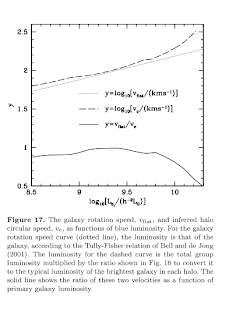
I think it is an important article, because it is observational, and worth citing while discussing the halo/galaxy velocities issue (the ratio of v_c/v_200 is around 1.2, at least from the simulations, not close to 1 as they find here). Anyway, I'll remember this article in case I have enough time to work on the velocity function.
Authors: Eke, Baugh, Cole et al.
Year: 2006, http://adsabs.harvard.edu/abs/2006MNRAS.370.1147E
The authors determine the galaxy groups mass and luminosity functions from 2dFGRS Percolation-Inferred Galaxy Group (2PIGG) catalogue (getting about 29 000 groups). The catalogue and the mock catalogues used to determine and correct for bias are described in Eke 2004 paper.
They obtain dynamical masses of the clusters (I think they use the words 'cluster' and 'group' interchangeably here) from their velocity dispersions, and obtain their luminosities by simply adding up the members' luminosities with weighting to account for spectroscopic incompleteness and galaxies below the flux limit. Then they correct the mass and luminosity functions using the Vmax method. However, they claim that a more robust way to determine the group mass function is deriving it from the luminosity function by multiplying it by a mass-to-light ratio. They also show that the total group luminosity function depends on the group finding algorithm used.
The main goal of the article is to determine the \sigma_8 parameter, but they make a comparison between halo velocities and circular velocities, claiming that the two are similar. The authors claim it is possible to convert a halo luminosity to its circular rotation velocity directly, then convert group luminosities (which are very similar to those of the brightest galaxy of the group) to circular velocities using Bell & de Jong B-band TF relation, and compare the two (see the attached figure).

I think it is an important article, because it is observational, and worth citing while discussing the halo/galaxy velocities issue (the ratio of v_c/v_200 is around 1.2, at least from the simulations, not close to 1 as they find here). Anyway, I'll remember this article in case I have enough time to work on the velocity function.
Subscribe to:
Posts (Atom)