Showing posts with label models. Show all posts

Thursday, November 14, 2013

Daily paper: The Tully-Fisher relations of early-type spiral and S0 galaxies

I gave a talk at our group meeting yesterday, this was one of several useful suggestions and references I got. bWilliams et al. 2010, The Tully-Fisher relations of early-type spiral and S0 galaxies
Offsets which are ascribed to fading or brightening could in fact be due to systematic biases that differ between the measures of rotation used. For typical slopes of the TFR, a relatively small systematic difference in velocity of ∼0.1 dex introduces an offset in the TFR that is indistinguishable from a ∼ 1mag difference in luminosity.
Our conclusions in this section have three consequences for previous works that measure the TFR of S0 galaxies using stellar kinematics corrected for asymmetric drift (e.g. Neistein et al. 1999; Hinz et al. 2001, 2003, BAM06): (i) the asymmetric drift correction they use yields similar results to detailed Jeans modelling; (ii) the drift correction does not seem to introduce a systematic bias between spirals and S0s and, if applied to samples of both spirals and S0s, can indeed be used to compare the TFRs of the two classes; (iii) however, a TFR derived from asymmetric drift-corrected stellar kinematics cannot be directly compared to TFRs derived from global HI line widths or resolved emission line PVDs.
==== There's a really interesting section on the ADC, and a nice comparison of gas/HI/AD corrected stellar kinematics. Also I should check their section on TFR fitting, intrinsic scatter in it, etc.In addition, I ought to take a look at the references therein, esp. the introduction.

Wednesday, May 15, 2013

Daily Paper #4: Dark halo response and the stellar initial mass function in early-type and late-type galaxies

Our group meeting ate most of my day, so here's a delayed review. Title: Dark halo response and the stellar initial mass function in early-type and late-type galaxies
Authors: Dutton, Conroy, van den Bosch et al., http://arxiv.org/abs/1012.5859
Year: 2011
The authors try to find the origins of the TF and Faber-Jackson relations, using a big sample of observed galaxies from SDSS, a set of observational scaling relations showing the distribution of baryons in galaxies, with constrains on the DM halo structure from simulations.
They claim in the introduction that the origin of TFR and FJR is the relation between the halo virial velocity and its virial mass, which scales as v_vir \propto M^(1/3). The relation between v_opt (*) and v_vir depends on 3 factors:
-- the contribution of baryons to v_opt
-- the structure of pristine (DM-only) haloes. The halo profiles are well-enough defined by the NFW profile.
-- and the halo response to the disk formation (contraction/expansion)
The biggest source of uncertainty for the first factor is the IMF, as most of the baryonic mass in galaxies (except the low-mass star-forming ones) is in stars.
The third factor, the halo response, is quite uncertain. It can be adiabatic or non-adiabatic contraction, or expansion due to a number of different processes.
They use a large number of observed relations (TF and FJ relations too) to constrain or predict unknown quantities in their analytic model, modelling the DM halo, bulges, disks, gas disks, constructing 3D models of their SDSS sample galaxies (~100 000 LTGs, ~160 000 ETGs).
They construct mass models for all those galaxies using various IMF and assumptions about the halo response. Then they compare them with the observed circular velocity -- stellar mass relations (I do not understand it at this point -- they already used the TFR as a constraint while solving for the halo contraction at a given IMF, so it is inbuilt in their model somehow?).
Nevertheless, they do not reproduce the zero-point of the TFR with the standard Chabrier IMF and standard adiabatic halo contraction model, as the velocity is overpredicted. They claim that it is possible to fix that by either assuming a different IMF, or changing the halo response, or having different halo concentrations (set by formation time or \sigma_8, they claim that both ways to do it do not solve the zero-point problem).
However, they find that early-type and late-type galaxies cannot have the same IMF and halo response. For any given halo response model, ETGs and LTGs must have different IMF normalisations to reproduce the TFR. If we assume a universal IMF, early-type galaxies require stronger halo contraction.
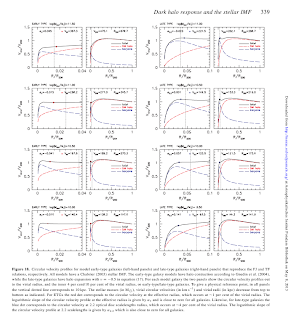
They look into the model circular velocity profiles (see attached) for models that reproduce the TF and FJRs, with Chabrier IMF. The velocity profiles look rather constant at higher radii, reaching the maximum at ~0.3 R_vir. (For the LTGs, they convert the velocity dispersion to v_circ picking a rather simple conversion factor between sqrt(2) and sqrt(3).) They claim that the flatness of the rotation curves does not depend strongly on the IMF and the halo response model, and 'is a natural consequence for galaxies embedded in LCDM haloes'.
Then they discuss possible mechanisms that would account for differences in IMF or halo response for ETGs and LTGs. The halo contraction/expansion may depend on galaxy morphology via a number of processes:
-- adiabatic contraction due to smooth accretion -- results in disk growth and SF, important for LTGs
-- wet major mergers -- result in halo contraction because gas settles in the center of a galaxy, transforms LTGs to ellipticals
-- dry major mergers ( for ETGs) -- halo contraction due to violent relaxation which mixes stars and DM
-- clumpy accretion/minor mergers: halo expansion due to dynamical friction. Clumps must be baryonic, so that's likely to occur at high redshifts (A. Dekel was arguing in Jerusalem that it must be the case).
-- feedback causes halo expansion, more important to LTGs and for higher redshifts.
-- bars -- halo expansion or contraction, not clear.

They sum it all up by saying that the key formation event that distinguishes ETGs from LTGs is a major merger (dry or wet), which causes halo contraction. For LTGs, haloes could expand due to a combination of clumpy cold accretion and intensive feedback.
The IMF may plausibly vary with redshift due to its alleged dependence on ISM temperature via the Jeans mass. Since ETGs form their stars earlier than LTGs, their IMF might be different. They discuss the van Dokkum & Conroy 2008 article on the different IMF at the cores of massive ellipticals, and conclude that this IMF would not fit for the other ETGs well.
All in all, they show that there is a degeneracy between IMF and the halo response to disk formation, and we cannot match the two for ETGs and LTGs if we want to reproduce the TFR. However, I'm puzzled here -- like in the previous Mo, Mao, White article, they do not model galaxy evolution in a self-contained way, and a model cannot show things that are not included in it. Mo, Mao & White include one set of parameters in their article, and get a set dependences on their parameters (like the disk formation time). Here Dutton et al. model rotation curves as functions of other parameters, and get dependence on another set of parameters. I think it's tricky to understand which parameters are really important, because in astrophysics we often have many coupled parameters, and it's not difficult to find correlations between them. It's more difficult to find out which ones are the fundamental ones, which really affect the TFR.
-- a question: what does it mean "TFR is an edge-on projection of the fundamental plane" (p. 323)?
(*) v2.2 for late-type galaxies and some measure of velocity proportional to dispersion at the effective radius for early types

Tuesday, May 14, 2013

Daily Paper #3: Rotation rates, sizes and star formation efficiencies of a representative population of simulated disc galaxies

I was a bit late today, because I went to see a couple of talks at the HETDEX meeting. A couple of interesting points from there:
-- The LAE people are worried about selection bias arising due to galaxy spins' alignment with the large scale structure (http://arxiv.org/abs/1004.3611)
-- Cluster growth depends not only on the proto-cluster environment (i.e. the immediate neighbourhood), but on super-halo scales as well (it's probably better defined here: http://arxiv.org/abs/1109.6328)

...On to the paper:
Title: Rotation rates, sizes and star formation efficiencies of a representative population of simulated disc galaxies
Authors: McCarthy, Schaye et al.
Year: 2012, http://arxiv.org/abs/1204.5195 They use resimulated (SPH) Millenium sub-regions with selected representative mean densities, including baryonic physics. They include background UV/Xray radiation field that 'reionises' the simulations at z = 9 and the CMB. They model star formation using an effective prescription reproducing the Kennicut's relation and assuming Chabrier IMF, as well as yields and timing of nucleosynthesis and SN feedback.
Then they fit the surface brightness profiles of galaxies in 9 - 11.5 log M* range with a Sersic function and classify their galaxies into disc and spheroid-dominated usin n = 2.5 as the cut.
-- The stellar mass - rotation velocity relation:
They examine this relation for their disk galaxy population (see the attached picture) and compare it with Reyes 2011 observations, claiming that this is the first cosmological hydrodynamical simulation that produces a population of galaxies consistent with the observed TFR. The slope is slightly higher, but in general, the agreement is really good. They use v80 (velocity at 80% light radius) and Vmax as the velocity measures. The velocities at their high-mass range are too big, and they claim that lack of prescription for AGN feedback may explain that.
The authors also discuss the scatter in TF relation, claiming that it is not possible to directly compare observed and simulated TF scatter without careful analysis of selection criteria and observational uncertainties.
Simulated spheroid galaxies follow the TFR well at this mass range, except for the most massive galaxies. The rotation curves of the galaxies with M* > 10.6 are not realistic (due to overcooling, too efficient SF of the highest mass haloes). Their simulated galaxies are also compatible with observed M* - size and star formation efficiency -- M* relations, up to the higher mass range.
One more quantity that simulations are compared with is the ratio of v_circ to v_200. If there is no significant halo expansion/contraction, this ratio should be roughly equal to 1.2 (Duffy 2010 writes more on halo expansion/contraction issue and impact on this ratio). Again, their results agree with this quite well up to log(M*) > 10.5.
They try to reproduce the main galaxy sequence at z = 0, comparing their results with SFR from Galex. Except for the lowest mass galaxies where their resolution is too small, it works well.
The section 4 is an interesting discussion of connection between SF efficiency, stellar mass function and the TF relation. They show that by assuming power-law shapes for halo mass function and stellar mass function in certain stellar mass range where this is valid, it is possible to match haloes (=velocities) and stellar masses using the abundance matching method, and reproduce TFR and SFR efficiency-M200 relations well (and maybe even constrain the faint end of the IMF). The way I understand it, the TFR arises due to the linear (in log-space) match between the halo mass function (set by cosmology) and the stellar mass function (set by IMF, SFR efficiency, thus feedback, etc.). I'll read Mo, van den Bosch and White 2010 for more discussion on this matter.

Monday, May 13, 2013

Daily Paper #2: The Tully-Fisher Zero Point Problem

Today's is a short paper (conference proceedings, just 4 or so pages), dealing with the halo contraction/expansion issue.

Title: The Tully-Fisher Zero Point Problem
Authors: Dutton, van den Bosch & Courteau
Year: 2008, http://arxiv.org/abs/0801.1505

The authors claim that CDM-based disk formation models can reproduce the slope/scatter of the TFR, however, its zeropoint has not been matched. This problem gets even worse if additional constraints (disk sizes, number densities) are imposed.
The TFR zeropoint can be matched in models if the halo contraction or disk self-gravity are not taken into account, or, as is shown in the article, halo contraction is counteracted by baryon feedback. They model an exponential disk in a NFW halo, obtain its luminosity from observed TFR and its scale-length from the size-luminosity relation. Assuming WMAP3 cosmology and a concentration parameter value from simulations, they solve for the virial mass and obtain rotation curves with and without the halo contraction (see the attached plot). The halo-contraction case is in conflict with both theory and observations, meaning that the halo is too small and has too high spin parameter.
They suggest 3 ways to solve this problem:
  • -- lower the stellar mass-to-light ratio (but there is no known IMF that could provide that). Also, they claim that baryons at the disk and bulge account for at least half of the v2.2 -- I didn't know that (Courteau 1999, Weiner 2001)!
  • -- lower the initial concentration (then the virial radius of a halo is increased) -- but that's incompatible with WMAP3 cosmology.
  • -- turn off or reverse halo contraction: disk galaxies do not form in isolated haloes by smooth cooling. Halo contraction can be reversed by:
    • a) Feedback during adiabatic disk formation, if a large fraction of its mass is removed. It would also explain why galaxy formation is so inefficient (I think they mean that the gas is not converted into stars rapidly).
    • b) Dynamic friction between baryons and DM due to bars or large baryonic clumps (do they mean violent disk instabilities here?). They do not explain the details of such a process here, but I think what happens is that baryons transfer some of their angular momentum to the halo due to formation of massive, concentrated, rapidly moving structures.
The interesting message of the article is that the TFR zeropoint can provide clues into baryon feedback (which should also explain the core-cusp problem of DM haloes, at least that was what A. Dekel and J. Primack maintained at the Jerusalem Winter School). That's important.

Friday, May 10, 2013

Daily Paper: The formation of galactic discs

Me and my supervisor agreed that I would read a paper a day and write it up, so I'll be copying the summaries here.

Title: The formation of galactic discs (http://adsabs.harvard.edu/abs/1998MNRAS.295..319M)
Authors: Mo, Mao, White
Year: 1998
It's actually a really important paper -- I'm glad not to have missed it. They model galactic disk formation (of pure exponential ones, though they address influence of a simple bulge model later) in 3 CDM cosmologies. The authors make 4 important assumptions:
1) The mass of a disk is a fixed fraction of its halo
2) The angular momentum of the disk is also a fixed fraction of that of the DM halo (later they find that the specific angular momenta of the disk and halo are similar, so these two ratios should be equal).
3) The disk is thin, has an exponential density profile and is centrifugally supported
4) Real galaxies are dynamically stable disks, i.e. they reject unstable models.

They calculate the halo mass function using Press-Schechter formalism (see Appendix), assume halo angular momentum distribution determined by N-body simulations and a constant mass-to light ratio, and NFW profile. They calculate the total energy of a truncated (to r_200) NFW halo using the virial theorem, the rotation curve corresponding to it (after accounting for adiabatic halo contraction and gravitational disk influence).
See the attached picture (Mo1998_rotcurves.png) for their results. They claim that the shape of a rotation curve depends on 3 parameters only: the halo concentration parameter c(see *), fraction of mass in the disk m_d, and the spin parameter.

There is a lot more in this paper, but they devote a significant section of it to Tully-Fisher relation, explaining the origins of its slope, zeropoint and intrinsic scatter.
  • -- slope: They claim that it is a generic prediction of hierarchical structure formation models with CDM-like fluctuation spectra (which set the halo formation times and thus their concentration c distribution).
  • -- zeropoint: mostly set on disk mass fraction, mass-to-light radio and the redshift at which a given disk was assembled. They claim that disks must have effectively formed at redshifts close to zero (?), unless we assume an unphysical mass-to-light ratio.
  • -- scatter: they analyse possible sources of intrinsic scatter of the disks, and find that:
    • --- a small amount of scatter comes from the spin parameter distribution
    • --- scatter in concentration c also adds scatter to the TF relation (disks at more concentrated haloes spin faster).
    • --- bulge is not included in their model, so bulge luminosity contribution is not accounted for -- that's a source of scatter as well
    • --- mass-to-light ratio may vary, adding some more scatter
    • --- formation times may vary as well, adding even more scatter.

The intrinsic scatter because of the first two factors cannot be smaller than 0.15 mag.
In conclusion, they show that it is possible to derive a realistic TF relation theoretically, however, I'm not sure if that is the only way it could arise? They do not include bulges, which are important for our sample, too. I am also unsure what do they mean with 'effective disk assembly redshift' at z <= 1.

* c == r_200/r_s, here r_200 -- the limiting radius of a halo, defined so that the mean density inside this radius is 200 times larger than the background density, r_s -- the disk scale length.
There is also a brief explanation of the \sigma_8 parameter -- see attached.

Thursday, March 14, 2013

Fitting a model to data: lit review

Yesterday I showed some preliminary TF results at our group meeting, and it was rightly noted that the straight line fit I made was wrong. I've only included errors in one variable (velocity, obtained by using bootstrapping) in the fit, and made a mess of that by mixing the variables on the plot.
I've been thinking about how to do a proper fit when the data has uncertainties in both directions, and been revisiting this paper by Hogg et al.:
In the astrophysics literature (see, for example, the Tully Fisher literature, there is a tradition, when there are uncertainties in both directions, of fi tting the "forward" and "reverse" relations, that is, fi tting y as a function of x and then x as a function of y, and then splitting the diff erence between the two slopes so obtained, or treating the di fference between the slopes as a systematic uncertainty. This is unjusti ed.

Thursday, January 24, 2013

lit: Asymmetric Drift and the Stellar Velocity ellipsoid

Asymmetric Drift and the Stellar Veloocity ellipsoid by Westfall, Bershady et al.:
The shape of the stellar velocity ellipsoid, defined by \sigma_R, \sigma_{phi}, and \sigma_z, provides key insights into the dynamical state of a galactic disk: \sigm_z:\sigma_R provides a measure of disk heating and  \sigma_{phi}:\sigma_R yields a check on the validity of the epicycle approximation (EA). Additionally, \sigma_R is a key component in measuring the stability criterion and in correcting rotation curves for asymmetric drift (AD), while \sigma_z is required for measuring the disk mass-to-light ratio.
See also p.2 on asymmetric drift corrections for stellar velocities.

Monday, January 14, 2013

Jerusalem WS lecture notes: 16. Signatures of Inflows and Outflows

By R. Dave, slides here.
  • metals in diffuse IGM -- outflows!
  • at high z, SF can't keep up with inflow: the gas accumulation phase: gas can even turn into molecular phase, but due to low efficiency it won't all be processed into stars (equilibrium breaks down), RD 2012
  • eta scaling ~ M_{halo} ^{-1/3} -- z_{equil} ~ 5 for massive galaxies
  • equilibrium model code at http://ursa.as.arizona.edu/~/rad/work/equil.c
  • 'thesis back in the stone age'
  • constraining outflow parameters: direct observation and direct modelling are challenging
  • direct observation of preventive feedback:
    • mass in CGM: gas in absorption, X-ray emission, soft X-ray bg: COS (Cosmic Origins Spectrograph): OVI high ionisation line, 2 components: photo- and collisional excitation: SF galaxies are probing 300 000 K gas: http://sci.esa.int/science-e/www/object/index.cfm?fobjectid=49663, Anderson 2012
    • direct observations of ejective feedback: outflowing ISM lines: LBG tomography
    • direct observations of wind recycling: _metallicity_ of inflowing gas. Disk outskirts: \alpha_z ~ 0.3
  • indirect constraints:
    • counting statistics are not as good as scaling relations
    • galaxies to 0th order are a 1-parameter family (stellar or halo mass) --> good scaling parameters
    • conversion efficiency peaks at 10^{12} M_{\odot}
    • if you don't have winds, you have overcooling problems
    • cosmic SFR efficiency: SFR vs. Halo mass infall rate: a simple combination of model parameters (Behroozi et al), simulations are hard
    • SFR vs. M_{\odot}: galaxy MS is the parameter to compare SF galaxies across redshifts, not SFR -- present starbursts and past normal SF galaxies have identical SFRs
    • MS evolution is currently difficult to model
    • SFR -- metallicity relation
    • M_{star} -- feedback relation
    • M_{star} function -- Baldry 2008 simulations -- reproduces the lower mass GSMF well, arbitrary quenching at logM > 11, governed by differential recycling which flattens the relation at intermediate masses --> inflection
    • gas fractions and X_{co}
  • DLAs: kinematics favor ejection, not prevention, CDM has many low-mass halos, if they have many HI, too many narrow DLAs result

Jerusalem WS lecture notes: 13. Galaxy Formation with Inflows and Outflows

By R. Dave, slides here.
  • 4 phases of baryons:
    • diffuse
    • unbound shock-heated
    • virial shock-heated (condensed)
    • cool halo gas (condensed)
    • low mas haloes cannot keep their gas
  • how gas gets into galaxies:
    • hot mode (shock heating at virial radius, cooling onto disk. slower, limited by cooling time, more spherical)
    • cool mode: more rapid, line emission cooled, filamentary: cold streams (dominant: cold accretion dominates globally, mergers are a small contribution to gas supply: SF is supply-limited)
    • mergers: DM grows by mergers (mass fn is steep), mergers contribute little to gas supply
    • mass dependence of accretion mode: large halos: hot mode, small halos: cold mode, separation at roughly ~10^{11.5} M_{\odot}, with metal cooling -- 10^{12} M_{\odot} -- connection with galaxy bimodality
  • shock stability: shocks form up from a certain mass, that's why cold mode dominates (virial shocks cannot form)
  • simulations
  • accretion w/out feedback overpredicts cold baryon mass (overcooling): conversion efficiency peaks at 10 ^{12}
  • red and dead: AGN feedback as the power source, blue: SNe, YSOs
  • abundance matching: equate nr density of haloes and galaxies with a given mass -- halo occupation distribution -- galaxies and satellites. Procedure assigns galaxies to haloes, matching halo masses to stellar masses, Behroozi +13 -- peak of conversion efficiency constant at all redshifts.
  • galaxies are gas processing factories: raw materials from IGM (infall rate due to gravity)
    • not all infall material ends up in the galaxy -- some gas is prevented from getting into the galaxy, outflow of hot and polluted gas from SF regions (just like in a factory), some outflow material is recaptured -- infall metallicity (\alpha_z in the diagram)
    • resulting SF: mass balance: infall = formed stars + Outflow + gas reservoir change
    • equilibrium condition: reservoir gas is constant over time (from hydro and obs, not true for dwarfs, just for L_{\star}) --> high z galaxies have higher ISM gas fractions
  • Inflow: primordial and recycled gas: recycling metallicity vs. SN ejecta metallicity
  • SFR: set by 3 baryon cycling parameters:
    • feedback preventing parameter (inflow)
    • outflow mass loading factor (outflow)
    • recycled wind metallicity ratio
  • SFH does not depend on (it's expressed in correlations):
    • SF law
    • merger history
    • environment or clustering
    • morphology
    • gas content
  • MS of galaxy evolution: SFR vs. M_{\star}:
    • relation should be close to linear, D. Elbaz
    • SFR should grow with z rapidly --> feeding rate change
  • feedback parameters:
    • quenching at high mass (AGN?)
    • gravitational heating transition to hot mode (\zeta_{grav}, RD 2012) -- power law all the way to high masses, weak dependence on z
    • wind heating suppress accretion
    • specific SFR: feedback effects
    • gas metallicity relation, its evolution -- gas phase metallicities
  • gas content, M_{gas} -- cold gas in the ISM:
    • H_2 gas fraction ~= t_{dep} \cdot sSFR (how much gas is in the ISM that waits to become stars)
    • depletion time t_{dep}
    • t_{dep}: depends on Schmidt law, Kennicutt relation
    • SF law sets t_{dep}, which sets f_{gas} ~ t_{dep}
  • the role of merging: second order effect (like environment), sets scatter (e.g. M_{star}-Z relation)
    • first order: smooth accretion
    • second order: stochasticity: clumps (mergers) --> lower Z, higher SFR (signals recent accretion event) --> high star formation points lie below MZ relation
    • dilution time -- explains scatter

Wednesday, January 2, 2013

Jerusalem WS lecture notes: 09. the IMF and the SFR

By M. Krumholz, slides here. I especially liked Mark's lectures, because he wades into murky, difficult topics of the ISM physics that many researchers like to leave out and assume something.
  • THE 2 problems
  • IMF:
    • determines stellar feedback (more at top-heavy IMF, etc), abundances, stellar masses
    • Observations:
    • Bastian 2010 -- MW MF plot http://arxiv.org/abs/1001.2965 -- universal IMF in different regions
    • Why a typical star is a few 10ths M_{\odot}? Insensitive to SF environment, metallicity, dwarf/spiral galaxy type
    • Andersen 2009: IMF in MCs (brightest HII region in the Local Group). Sabbi 2008: in SMC (0.2 Z_{\odot})
    • Variation in cDs? van Dokkum & Conroy 2010 (unresolved stars, red & dead galaxies, stars formed at z = 2) -- http://www.nature.com/nature/journal/v468/n7326/abs/nature09578.html: "The direct detection of the light of low-mass stars implies that they are very abundant in elliptical galaxies, making up over 80% of the total number of stars and contributing more than 60% of the total stellar mass. We infer that the IMF in massive star-forming galaxies in the early Universe produced many more low-mass stars than the IMF in the Milky Way disk, and was probably slightly steeper than the Salpeter form in the mass range 0.1M_{\odot} to 1M_{\odot}"
    • Peak location: non-isothermality is required, comes either from:
    • galactic properties, e.g. Hopkins 2012
    • local non-isothermality approximation:
    • isothermality broken by star formation: accreting star is brighter than non-accreting star --> Krumholz 2012: the characteristic mass is set by deviation from isothermality due to SF, the characteristic mass (peak location) depends on pressure of the core (lower mass at higher p). Pressure is set by balance vs. gravity (surface density)
    • Slope: universal, probably due to turbulence
  • SFR:
    • bathtub model (gas in, gas out) when t_{SF} << t_H
    • Correlation b/ween molecular gas SD and SF on galactic scales
    • sub-galactic scales: cloud mass vs. no of YSOs, IR luminosity vs. amount of gas (Wu 2005)
    • Galaxy metallicity dependence
    • phase dependence
    • SFR is a function of Toomre Q in galaxy. Dobbs 2011 simulation: self-regulation
    • Top-down model is not sufficient
    • Bottom-up model: what matters is the small scales (local SF law)
    • Why is \epsilon_{eff} (gas conversion to stars ratio) so low, ~1%? Federrath & Klessen 2012 --> few % efficiency for turbulent, virialised objects.
    • l_s -- sound length, size scaling
    • metallicity-phase dependence:
    • why most of the gas is atomic? Dissociation by UV, except in areas where UV is shielded by dust or H_2, 'magic number' -- surface density that shields, ~10M_{\odot}/pc^2
    • why SF follows H_2? Photons that are responsible for dissociation of H_2, are the same that heat the gas, so if the gas is shielded, it cools --> H_2
    • extragalactic phase dependence (SMC has a different SF law because of different metallicity). SF is not only self-regulating process, it depends on global galaxy properties

Monday, November 26, 2012

some Python scripts from Durham

A pile of interesting astrophysics scripts, especially the one creating images from GALFIT output files and the other plotting Petrosian quantities for different n.

Thursday, October 11, 2012

A wrapper for wrapper for kcorrect

A little script I cobbled together in order to feed the data to kcorrect, and save its output (absolute ugriz magnitudes and stellar masses, in this case).

Thursday, August 16, 2012

Bulges and ellipticals

I read an interesting article on the train, Galaxy Bulges and Elliptical Galaxies, lecture notes by D. Gadotti. Dimitri had helped us a lot with the MICE decomposition.
He sums up a great deal of recent research regarding the structure of galaxies. A few main points:
  • the components that we call bulges are not necessarily old 'scaled down' ellipticals as we often hear: there are classical bulges, disk-like bulges, 'box-peanuts', which may coexist or overlap.
  • 'box-peanuts' are thought to be the inner parts of bars, not separate components
  • classical bulges are kinematically hot, i.e. supported by their velocity dispersion. disk-like bulges are kinematically cold, i.e. supported by their rotation velocity.
  • there's an interesting section on photometric bulge recognition, and why the arbitrary cut on n=2 is what it is, arbitrary. I tend to believe that any classification has to be data-driven, so I'll keep the alternative suggestions in mind.
  • another interesting part is about the scaling relations, i.e. the fundamental plane and F-J relation. I didn't know that the FP can be derived directly from the virial theorem!
  • F-J and L-size relations seem to be nonlinear, according to the data.
The only thing I'm not sure about is the use of 2D K-S test, an enlightening read otherwise.

Saturday, May 26, 2012

SDSS axis ratio measures

I copy it verbatim from here, to have a reference ready.

The model fits yield an estimate of the axis ratio and position angle of each object, but it is useful to have model-independent measures of ellipticity. In the data released here, frames provides two further measures of ellipticity, one based on second moments, the other based on the ellipticity of a particular isophote. The model fits do correctly account for the effect of the seeing, while the methods presented here do not.

The first method measures flux-weighted second moments, defined as:

  • Mxx = x^2/r^2
  • Myy = y^2/r^2
  • Mxy = x^y/r^2

In the case that the object's isophotes are self-similar ellipses, one can show:

  • Q = Mxx - Myy = [(a-b)/(a+b)]cos2φ
  • U = Mxy = [(a-b)/(a+b)]sin2φ

where a and b are the semi-major and semi-minor axes, and φ is the position angle. Q and U are Q and U in PhotoObj and are referred to as "Stokes parameters." They can be used to reconstruct the axis ratio and position angle, measured relative to row and column of the CCDs. This is equivalent to the normal definition of position angle (East of North), for the scans on the Equator. The performance of the Stokes parameters are not ideal at low S/N. For future data releases, frames will also output variants of the adaptive shape measures used in the weak lensing analysis of Fischer et al. (2000), which are closer to optimal measures of shape for small objects.

Isophotal Quantities

A second measure of ellipticity is given by measuring the ellipticity of the 25 magnitudes per square arcsecond isophote (in all bands). In detail, frames measures the radius of a particular isophote as a function of angle and Fourier expands this function. It then extracts from the coefficients the centroid (isoRowC,isoColC), major and minor axis (isoA,isoB), position angle (isoPhi), and average radius of the isophote in question (Profile). Placeholders exist in the database for the errors on each of these quantities, but they are not currently calculated. It also reports the derivative of each of these quantities with respect to isophote level, necessary to recompute these quantities if the photometric calibration changes.

Many more about those second order moments, and why they are called 'Stokes' parameters' can be found in references herein.

Tuesday, March 20, 2012

the end of MICE

I'm about to finish running GALFIT on the HST F606 MICE image (preview here).
I've used GALFIT before, while writing my MSc thesis, but oh, those were faint, redshifted and unremarkable SDSS galaxies. That was simple -- I used 5 components once, because a galaxy had a LINER AGN.
The MICE are monsters. They've apparently already passed through each other once, and have highly disturbed tidal features, clumps of active star formation, dust lanes, you name it. I've never used GALFIT to model spiral arms, too, so that was an interesting experience.
Here are they:

I started simple, first masking out each galaxy and fitting the other in turn, then fitting both simultaneously (that's a better way to do it anyway). After running about 150 models I decided to mask out the dark dust lanes in galaxy A -- I couldn't fit them using truncation functions, as GALFIT crashes (on my 64bit SUSE, at least) while attempting that and I don't think the science goal required this. I have some reservations about the decomposition, as I think the image has some flat-fielding issues, besides, the galaxies take up a large part of the overall image, so I have doubts about the determined sky value as well.
In the end I had 91 free parameter, and I think more might have made sense, but that was past the point of diminishing returns. I stopped at Chi^2 = 1.877, and guess the main reason why the model would fit the image so poorly were the bright and irregular cores of the galaxies -- or possible higher order flat-field curvature. The other objects were masked out.
Here is the model -- at ds9's 99.5 scale and heat colourmap (this is handy: ds9 -scale mode 99.5 -cmap Heat -medatacube ~/workspace/MICE/galfit/subcomps.fits). The long, bright tails are not well visible with these settings, but they weren't the goal.
I am not really happy with the residual picture, as it tells me there are some big, obscured components lurking underneath. But that'll have to do for the moment, as I have other assignments. I've been doing this for other people in the collaboration, so I don't think I can publish the fit logs here, unfortunately.