Romanowsky and Fall 2012 -- See the discussion of mass and angular momentum as the main parameters for galaxies, also the appendix for deprojection.
Showing posts with label research material. Show all posts
Showing posts with label research material. Show all posts
Friday, November 29, 2013

Thursday, November 28, 2013
lit: The Zeldovich approximation: key to understanding Cosmic Web complexity
Hidding, Shandarin et al. 2013: seems interesting, modelling the structure of the cosmic web.
Thursday, November 14, 2013
Daily paper: The Tully-Fisher relations of early-type spiral and S0 galaxies
I gave a talk at our group meeting yesterday, this was one of several useful suggestions and references I got.
bWilliams et al. 2010, The Tully-Fisher relations of early-type spiral and S0 galaxies
Offsets which are ascribed to fading or brightening could in fact be due to systematic biases that differ between the measures of rotation used. For typical slopes of the TFR, a relatively small systematic difference in velocity of ∼0.1 dex introduces an offset in the TFR that is indistinguishable from a ∼ 1mag difference in luminosity.
Our conclusions in this section have three consequences for previous works that measure the TFR of S0 galaxies using stellar kinematics corrected for asymmetric drift (e.g. Neistein et al. 1999; Hinz et al. 2001, 2003, BAM06): (i) the asymmetric drift correction they use yields similar results to detailed Jeans modelling; (ii) the drift correction does not seem to introduce a systematic bias between spirals and S0s and, if applied to samples of both spirals and S0s, can indeed be used to compare the TFRs of the two classes; (iii) however, a TFR derived from asymmetric drift-corrected stellar kinematics cannot be directly compared to TFRs derived from global HI line widths or resolved emission line PVDs. ==== There's a really interesting section on the ADC, and a nice comparison of gas/HI/AD corrected stellar kinematics. Also I should check their section on TFR fitting, intrinsic scatter in it, etc.In addition, I ought to take a look at the references therein, esp. the introduction.
Friday, November 8, 2013
Thursday, November 7, 2013
lit: The baryonic Tully–Fisher relation and galactic outflows
Dutton and van den Bosch 2009, also see Dutton et al. 2011.
lit: The baryonic Tully-Fisher relation and its implication for dark matter halos
Trachternach et al 2009: baryonic TFR as constraint of elongation of DM haloes.
Tuesday, October 8, 2013
lit: TF as a constraint on the temperature of WDM
Constraints on the temperature of Warm Dark Matter from the Galaxy Stellar Mass Function and Tully-Fisher Relation by Kang, Maccio, Dutton. One more reason why TFR is important!
Wednesday, September 25, 2013
lit: Precise TFRs without galaxy inclinations
Precise TFRs without galaxy inclinations, by Obreschkow et al. A really interesting read about why photometric (axis ratio-based) inclination values are not optimal, what TFR is good for, fitting the TFR, etc. The main point of the article is recovering the TFR for samples with limited or no inclination data, but I haven't read it in detail yet.
Monday, August 26, 2013
Fitting the Tully-Fisher relation
There's one thing I can't quite wrap my head around while reading literature on the Tully-Fisher relation: why is the fitting always performed in the magnitude-log(velocity) space? It may be easier to fit an expression y = mx + b to data than y = c*x**z, but one would have to deal with asymmetric errors in two dimensions.
I'm currently trying to figure out a way to do the fit in semi-log space, namely, magnitude-velocity space, using errors in both directions and MCMC.
I'm currently trying to figure out a way to do the fit in semi-log space, namely, magnitude-velocity space, using errors in both directions and MCMC.
Thursday, June 13, 2013
lit: Where do the dwarf galaxies go?
I've just attended a colloquium by J. Navarro of the NFW fame, which was really related to my current reading list. I'm writing an introductory chapter on hierarchical galaxy assembly for my thesis at the moment.
One unsolved problem of LCDM cosmology is the apparent lack of dwarf galaxies: simulations and statistical frameworks (such as EPS) predict that we should see a large number (hundreds) of dwarf galaxies around each bright galaxy such as the Milky Way, but we only know of a dozen. Same with Andromeda.
J. Navarro also showed some puzzling properties of local dwarfs, for example, the fact that their star formation histories are wildly different. Some formed all their gas 10 or so Gyr ago, some had a starburst recently, and some have double-peaked SFH's. He presented the work of his student which could explain it: the CLUES simulation shows that a combination of interaction with the collapsing cosmic web, mergers of dwarfs and reionisation stripping can in principle explain this. Some dwarfs lost their gas simply because they moved too fast through the cosmic web. The remainders of such galaxies may be just too faint for us to see.
Thursday, June 6, 2013
Daily Paper #12 -- The I-Band TF relation for Cluster Galaxies
Title: The I Band Tully-Fisher Relation for Cluster Galaxies: a Template Relation, its Scatter and Bias Corrections.
Authors:Giovanelli, Haynes et al.
Year:1997, http://adsabs.harvard.edu/abs/1997AJ....113...53G
This is a 'classic' Tully Fisher paper, still being cited often. Their TF relation is also widely used as the reference.
It is the seventh paper from a series with the same topic, presenting the corrections done and the TF relation fitting procedure. They use velocity widths and I magnitudes of 784 field and cluster galaxies.
They discuss biases occuring and TF scatter extensively, and there are quite a few enlightening observations. For example, while discussing the total observed scatter, they name three main causes for it:
They discuss the error propagation and relative importance of various error sources. One important, and in retrospect quite obvious fact is that that the relative importance of internal extinction correction errors depends on the inclination and intrinsic rotation velocity of a given galaxy: they are the largest for highly inclined, fast-rotating galaxies. Conversely, velocity errors are the most significant for nearly face-on, slowly rotating galaxies. That might be an interesting plot to show.
They discuss the implications of TF scatter too, citing Franx and de Zeeuw 1992 who claim that TF scatter poses a strong constraint on the ellipticity of the potential in the disk plane. Rix and Zaritsky, 1995 find that departures from disk axisymmetry can contribute as much as ~0.15 mag to the TF scatter (optical observations). Eisenstein and Loeb, 1996 find that the TF scatter due to different formation histories of galaxes can be larger than 0.3 mag in some cosmological scenarios (I remember reading that one: the intrinsic scatter of TF is surely smaller than that, and they try to find out why it is so, there must be some regularising factor at work).
They report a slight TF offset dependence on morphology -- this is of course band dependent. They also discuss a number of bias present, such as incompleteness bias (which they correct by fitting the LF), Malmquist bias, edge-of-catalogue bias, effects of cluster environment (which they find to be negligible).
I do not understand some of the corrections done here, namely, the morphological type correction (they add a term to magnitudes of early type galaxies in order to have a straight line TF relation -- why do they do it? Extinction corrections are likely to be different, and why such a TF relation would be useful?).
The residuals of the TFR can show if there are uncorrected selection effects -- i.e. if there is a dependency of them on inclination. However, I would not want to try to cram all galaxies into the same line, if they are intrinsically different. That'd be losing information, in my opinion.
Authors:Giovanelli, Haynes et al.
Year:1997, http://adsabs.harvard.edu/abs/1997AJ....113...53G
This is a 'classic' Tully Fisher paper, still being cited often. Their TF relation is also widely used as the reference.
It is the seventh paper from a series with the same topic, presenting the corrections done and the TF relation fitting procedure. They use velocity widths and I magnitudes of 784 field and cluster galaxies.
They discuss biases occuring and TF scatter extensively, and there are quite a few enlightening observations. For example, while discussing the total observed scatter, they name three main causes for it:
- Raw measurement errors (inclinations, apparent magnitudes, velocities)
- Uncertainties arising from corrections (extinction, inclination correction for velocities, asymmetric drift correction, turbulence, etc.)
- 'Cosmic scatter' -- velocity disk distortions, disk distortions, photometric asymmetries, variations in mass-to-light ratio, variation in disk-to-bulge-ratio, etc.
They discuss the error propagation and relative importance of various error sources. One important, and in retrospect quite obvious fact is that that the relative importance of internal extinction correction errors depends on the inclination and intrinsic rotation velocity of a given galaxy: they are the largest for highly inclined, fast-rotating galaxies. Conversely, velocity errors are the most significant for nearly face-on, slowly rotating galaxies. That might be an interesting plot to show.
They discuss the implications of TF scatter too, citing Franx and de Zeeuw 1992 who claim that TF scatter poses a strong constraint on the ellipticity of the potential in the disk plane. Rix and Zaritsky, 1995 find that departures from disk axisymmetry can contribute as much as ~0.15 mag to the TF scatter (optical observations). Eisenstein and Loeb, 1996 find that the TF scatter due to different formation histories of galaxes can be larger than 0.3 mag in some cosmological scenarios (I remember reading that one: the intrinsic scatter of TF is surely smaller than that, and they try to find out why it is so, there must be some regularising factor at work).
They report a slight TF offset dependence on morphology -- this is of course band dependent. They also discuss a number of bias present, such as incompleteness bias (which they correct by fitting the LF), Malmquist bias, edge-of-catalogue bias, effects of cluster environment (which they find to be negligible).
I do not understand some of the corrections done here, namely, the morphological type correction (they add a term to magnitudes of early type galaxies in order to have a straight line TF relation -- why do they do it? Extinction corrections are likely to be different, and why such a TF relation would be useful?).
The residuals of the TFR can show if there are uncorrected selection effects -- i.e. if there is a dependency of them on inclination. However, I would not want to try to cram all galaxies into the same line, if they are intrinsically different. That'd be losing information, in my opinion.
Tuesday, June 4, 2013
Daily Paper #11: The Origin of Disks and Spheroids in Simulated Galaxies
Title: The Origin of Disks and Spheroids in Simulated Galaxies
Authors:Sales, Navarro et al.
Year:2012, http://arxiv.org/abs/1112.2220
I picked this article because it challenges the standard idea of galaxy formation I had always been taught: that disks were assembled quite recently in rotating, quiescent haloes, whereas spheroidals are results of mergers (or primordial collapse, as my supervisor pointed out). In other words, current morphology is strongly dependent on the assembly history of the haloes.
They use GIMIC simulations I wrote about to obtain a sizeable sample of Milky Way mass range galaxies. Using a kinematic morphology criterion (\kappa_rot, the fraction of kinetic energy corresponding to the ordered rotation, they look for the origin of morphology of a given galaxy. Simulations show that disks can be formed in haloes of high and low spin parameter (Bullock 2001), in haloes that collapse early or late, in haloes that go through merger events.
They find that disks are preferably formed by slow accretion of gas from a hot corona, as opposed to cold flows (many people in Jerusalem claimed those were important at high redshift). Disks assemble slowly and gradually (see fig.6: A galaxy is a spheroid, D galaxy is a disk, BC -- intermediate steps), and hot corona gas accretion might explain that.
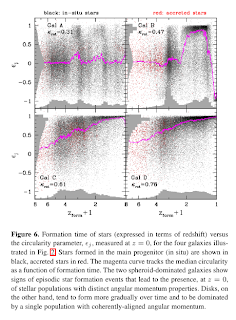 Gas accretion history is not the whole story. The authors claim that spin alignment of the accreted gas and the galaxy itself is more important: disks form when the two spin directions are similar, whereas spheroidals form when they are misaligned. Hot corona gas spends a lot of time inside the halo, it is forced to align its rotation with that of the halo and the galaxy itself. Spheroids form when a galaxy accretes a lot of cold gas via misaligned filaments, i.e. when the angular momenta of the galaxy and the gas are not aligned. Star formation in spheroidals proceeds in a bursty manner (due to a different channel of gas acquisition, not the slow and gradual corona gas accretion), leaving behind stars with different ages and angular momenta. Intermediate galaxies form when the spins are aligned, but the gas accreted is mostly cold.
The kinematic (at least) morphology is determined by the interplay of these two factors: in order to form a disk, a galaxy needs to have a lot of shock-heated gas in its corona, unless the spin misalignment between the spins the galaxy and the gas is too large. That may be only a part of the whole picture, as mergers may play a more important role in other mass ranges, they mention halo triaxiality and feedback as other potential factors of morphology. I think it is an interesting article, even if not directly related to TF. It reasserts what I had repeatedly heard in Jerusalem: that inflows and outflows are very important, and we do not know much about them. The results may be tested observationally: would it be possible to do something like fig.6 with CALIFA data?
Authors:Sales, Navarro et al.
Year:2012, http://arxiv.org/abs/1112.2220
I picked this article because it challenges the standard idea of galaxy formation I had always been taught: that disks were assembled quite recently in rotating, quiescent haloes, whereas spheroidals are results of mergers (or primordial collapse, as my supervisor pointed out). In other words, current morphology is strongly dependent on the assembly history of the haloes.
They use GIMIC simulations I wrote about to obtain a sizeable sample of Milky Way mass range galaxies. Using a kinematic morphology criterion (\kappa_rot, the fraction of kinetic energy corresponding to the ordered rotation, they look for the origin of morphology of a given galaxy. Simulations show that disks can be formed in haloes of high and low spin parameter (Bullock 2001), in haloes that collapse early or late, in haloes that go through merger events.
They find that disks are preferably formed by slow accretion of gas from a hot corona, as opposed to cold flows (many people in Jerusalem claimed those were important at high redshift). Disks assemble slowly and gradually (see fig.6: A galaxy is a spheroid, D galaxy is a disk, BC -- intermediate steps), and hot corona gas accretion might explain that.
 Gas accretion history is not the whole story. The authors claim that spin alignment of the accreted gas and the galaxy itself is more important: disks form when the two spin directions are similar, whereas spheroidals form when they are misaligned. Hot corona gas spends a lot of time inside the halo, it is forced to align its rotation with that of the halo and the galaxy itself. Spheroids form when a galaxy accretes a lot of cold gas via misaligned filaments, i.e. when the angular momenta of the galaxy and the gas are not aligned. Star formation in spheroidals proceeds in a bursty manner (due to a different channel of gas acquisition, not the slow and gradual corona gas accretion), leaving behind stars with different ages and angular momenta. Intermediate galaxies form when the spins are aligned, but the gas accreted is mostly cold.
The kinematic (at least) morphology is determined by the interplay of these two factors: in order to form a disk, a galaxy needs to have a lot of shock-heated gas in its corona, unless the spin misalignment between the spins the galaxy and the gas is too large. That may be only a part of the whole picture, as mergers may play a more important role in other mass ranges, they mention halo triaxiality and feedback as other potential factors of morphology. I think it is an interesting article, even if not directly related to TF. It reasserts what I had repeatedly heard in Jerusalem: that inflows and outflows are very important, and we do not know much about them. The results may be tested observationally: would it be possible to do something like fig.6 with CALIFA data?
Thursday, May 30, 2013
Daily Papers TODO: a collection of links
I'll be keeping the list of papers I want to read here.
Stellar Mass-to-Light Ratios and the Tully-Fisher Relation 3D Spectroscopy with VLT/GIRAFFE - IV: Angular Momentum and Dynamical Support of Intermediate Redshift Galaxies
ANGULAR MOMENTUM ACQUISITION IN GALAXY HALOS
The Baryonic TF relation -- we've discussed it before, but I need to write it up.
Stellar Mass-to-Light Ratios and the Tully-Fisher Relation 3D Spectroscopy with VLT/GIRAFFE - IV: Angular Momentum and Dynamical Support of Intermediate Redshift Galaxies
ANGULAR MOMENTUM ACQUISITION IN GALAXY HALOS
The Baryonic TF relation -- we've discussed it before, but I need to write it up.
Friday, May 24, 2013
Daily Paper #10: Reconstructed density and velocity fields from the 2MASS Redshift Survey
Today's article was referenced to in the WISE TF paper I summarised yesterday. I wanted to find out how the peculiar velocities and density fields were reconstructed.
Title: Reconstructed density and velocity fields from the 2MASS Redshift Survey
Authors: Erdoğdu, Lahav et al.
Year: 2006, http://mnras.oxfordjournals.org/content/373/1/45.full
I have to admit I did not understand the mathematics of this article, and will read Peebles 1973 and Fisher 1995 to understand what are the spherical harmonics and Fourier-Bessel functions in detail. What they do in order to transform the the redshift space to the real space is decompose the redshift space distribution into radial and angular components. Peculiar velocities affect only the radial component, so it is easier to deconvolve them.
The relationship between mass and light distribution is usually assumed to be linear with some proportionality constant (there is an article by Vivienne arguing that this is not the case).
They provide density and velocity maps up to cz = 16 0000 km/s, which covers the CALIFA redshift range. I could ask them for the velocity data and obtain the peculiar velocities/infall corrected distances for the sample. I think it would be useful for me later, when working with the density fields and spin alignments. We would also have these distances and their errors for all the galaxies, not only the ones identified as belonging to structures.
Previously I used the Virgo-GA-Shapley infall corrected redshifts from NED (obtained using this model: http://iopscience.iop.org/0004-637X/529/2/786/fulltext/). It's a simpler model, taking only these three attractors into account.
Thursday, May 23, 2013
Daily Paper #9: WISE TF: A Mid-infrared, 3.4-micron Extension of the Tully-Fisher Relation Using WISE Photometry
Here's the recent WISE paper my supervisor had sent me a link to.
Title:WISE TF: A Mid-infrared, 3.4-micron Extension of the Tully-Fisher Relation Using WISE Photometry
Authors: Lagattuta, Mould et al.
Year: 2013, http://arxiv.org/abs/1305.4637v1
In a way, this is a classic, straightforward observational TFR paper. They pick the shortest wavelength (3.4 um) WISE band, where dust emission is not very important, use archival HI linewidths from Hyperleda and Cornell HI archive and WISE photometry (w1gmag magnitudes). They also take morphological classifications from CfA ZCAT and axis ratios from V-band measurements in NED. They reject galaxies with low quality of radio observations and inclinations (from b/a) less than 45 deg, as well as all E galaxies.
What was interesting for me here was that they did a number of corrections in a thorough way, especially the peculiar velocities correction. Since their and CALIFA redshifts overlap, we might have to give more thought to this correction, as it can reduce scatter in the resulting TFR significantly. They use the Erdoglu 2006 model, interpolating over the velocity grid where necessary (I'll read it for tomorrow).
The intrinsic extinction correction are small in the mid IR, but not so in the SDSS r-band. I'll check Masters 2003 correction prescription too, maybe it's better than the one I'm using.
They also find a bend in their TFR, due to different morphological types -- like we do (the slopes for late and early spirals are different), which is worth mentioning! However, they normalise the magnitudes of the early types and force them to fit the late-type spirals relation. Since our sample is dominated by early-type spirals, I would not want to do that (and I'm not sure what physical basis there is for this correction).
There is a reference to a 2013 paper by Sorce et al., where it is claimed that redder galaxies lie above the TF relation, and the bluer ones lie below, that's interesting.
They also discuss the influence of a bulge to the scatter of TFR, which is larger at the IR and for massive galaxies -- I'll remember that.
What made me think is their conclusion that the mid-IR W1 and 2MASS K bands trace the same stellar populations, a significant fraction of which are in the central parts of the galaxies (thus, probably bulges, esp. in CALIFA sample). That is interesting, in part because we make the inclination and extinction corrections assuming the galaxies are thin disks. Also, we have to keep in mind that when we plot the TFR for different bands, we are relating disk rotation velocities with different morphological components of a galaxy, which do not necessarily correspond to the disk only!
Wednesday, May 22, 2013
Daily Paper #8: Constraints on the relationship between stellar mass and halo mass at low and high redshift
Title: Constraints on the relationship between stellar mass and halo mass at low and high redshift
Authors: Moster, Somerville et al.
Year: 2009, http://arxiv.org/abs/0903.4682
They give a nice breakdown of the methods used to link the halo properties with those of the galaxy. It is possible to obtain these relations from observations (kinematics, lensing, X-rays), from bottom-up modelling (N-body or SAMs), or by using a statistical approach: obtaining the probability that a halo with a certain mass hosts a certain number of galaxies with some certain properties (luminosity, type, etc.). This way, we don't have to make assumptions about feedback and other poorly-understood processes that plague the SAMs. I'll review the lecture recordings from Jerusalem School, I think the formalism used was explained in detail there.
The goal of this paper is to construct the conditional stellar mass function (as opposed to the conditional luminosity function). Such a function provides the average number of galaxies in a certain stellar mass range that reside in a halo with a mass M -- it can also be viewed as the stellar mass function for the haloes of mass M.
They use a N-body simulation to obtain a population of DM haloes and their merger tree information. The ratio of the halo mass M and the stellar mass M is not constant (due to different feedback processes), so they use a parameterisation of it to fill the haloes with galaxies, and obtain the stellar mass-Mhalo relation.
In order to obtain the conditional mass function, they divide the galaxies into centrals and satellites, parameterising their distribution in two different ways. The total CMF is the combination of the two.
They also obtain the M* -- M_halo relationship for higher redshifts, claiming that 'large halos accrete dark matter faster than large galaxies grow in stellar mass, while the growth of low mass halos is slower than that of the central galaxies they harbor', (see the attached picture).
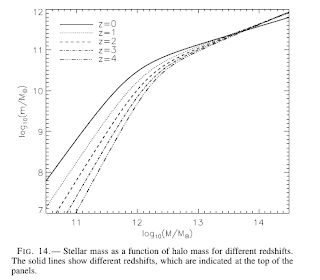
This paper does not mention the TF relation, however, I wanted to find out more about the M*-Mhalo relation, the ways to determine it and its evolution. It's interesting that the high-mass end of this relation does not evolve much since z=4.
Authors: Moster, Somerville et al.
Year: 2009, http://arxiv.org/abs/0903.4682
They give a nice breakdown of the methods used to link the halo properties with those of the galaxy. It is possible to obtain these relations from observations (kinematics, lensing, X-rays), from bottom-up modelling (N-body or SAMs), or by using a statistical approach: obtaining the probability that a halo with a certain mass hosts a certain number of galaxies with some certain properties (luminosity, type, etc.). This way, we don't have to make assumptions about feedback and other poorly-understood processes that plague the SAMs. I'll review the lecture recordings from Jerusalem School, I think the formalism used was explained in detail there.
The goal of this paper is to construct the conditional stellar mass function (as opposed to the conditional luminosity function). Such a function provides the average number of galaxies in a certain stellar mass range that reside in a halo with a mass M -- it can also be viewed as the stellar mass function for the haloes of mass M.
They use a N-body simulation to obtain a population of DM haloes and their merger tree information. The ratio of the halo mass M and the stellar mass M is not constant (due to different feedback processes), so they use a parameterisation of it to fill the haloes with galaxies, and obtain the stellar mass-Mhalo relation.
In order to obtain the conditional mass function, they divide the galaxies into centrals and satellites, parameterising their distribution in two different ways. The total CMF is the combination of the two.
They also obtain the M* -- M_halo relationship for higher redshifts, claiming that 'large halos accrete dark matter faster than large galaxies grow in stellar mass, while the growth of low mass halos is slower than that of the central galaxies they harbor', (see the attached picture).

This paper does not mention the TF relation, however, I wanted to find out more about the M*-Mhalo relation, the ways to determine it and its evolution. It's interesting that the high-mass end of this relation does not evolve much since z=4.
Daily Paper #7: Galaxy groups in the 2dFGRS: the number density of groups
Title: Galaxy groups in the 2dFGRS: the number density of
groups
Authors: Eke, Baugh, Cole et al.
Year: 2006, http://adsabs.harvard.edu/abs/2006MNRAS.370.1147E
The authors determine the galaxy groups mass and luminosity functions from 2dFGRS Percolation-Inferred Galaxy Group (2PIGG) catalogue (getting about 29 000 groups). The catalogue and the mock catalogues used to determine and correct for bias are described in Eke 2004 paper.
They obtain dynamical masses of the clusters (I think they use the words 'cluster' and 'group' interchangeably here) from their velocity dispersions, and obtain their luminosities by simply adding up the members' luminosities with weighting to account for spectroscopic incompleteness and galaxies below the flux limit. Then they correct the mass and luminosity functions using the Vmax method. However, they claim that a more robust way to determine the group mass function is deriving it from the luminosity function by multiplying it by a mass-to-light ratio. They also show that the total group luminosity function depends on the group finding algorithm used.
The main goal of the article is to determine the \sigma_8 parameter, but they make a comparison between halo velocities and circular velocities, claiming that the two are similar. The authors claim it is possible to convert a halo luminosity to its circular rotation velocity directly, then convert group luminosities (which are very similar to those of the brightest galaxy of the group) to circular velocities using Bell & de Jong B-band TF relation, and compare the two (see the attached figure).
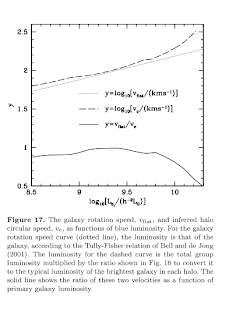
I think it is an important article, because it is observational, and worth citing while discussing the halo/galaxy velocities issue (the ratio of v_c/v_200 is around 1.2, at least from the simulations, not close to 1 as they find here). Anyway, I'll remember this article in case I have enough time to work on the velocity function.
Authors: Eke, Baugh, Cole et al.
Year: 2006, http://adsabs.harvard.edu/abs/2006MNRAS.370.1147E
The authors determine the galaxy groups mass and luminosity functions from 2dFGRS Percolation-Inferred Galaxy Group (2PIGG) catalogue (getting about 29 000 groups). The catalogue and the mock catalogues used to determine and correct for bias are described in Eke 2004 paper.
They obtain dynamical masses of the clusters (I think they use the words 'cluster' and 'group' interchangeably here) from their velocity dispersions, and obtain their luminosities by simply adding up the members' luminosities with weighting to account for spectroscopic incompleteness and galaxies below the flux limit. Then they correct the mass and luminosity functions using the Vmax method. However, they claim that a more robust way to determine the group mass function is deriving it from the luminosity function by multiplying it by a mass-to-light ratio. They also show that the total group luminosity function depends on the group finding algorithm used.
The main goal of the article is to determine the \sigma_8 parameter, but they make a comparison between halo velocities and circular velocities, claiming that the two are similar. The authors claim it is possible to convert a halo luminosity to its circular rotation velocity directly, then convert group luminosities (which are very similar to those of the brightest galaxy of the group) to circular velocities using Bell & de Jong B-band TF relation, and compare the two (see the attached figure).

I think it is an important article, because it is observational, and worth citing while discussing the halo/galaxy velocities issue (the ratio of v_c/v_200 is around 1.2, at least from the simulations, not close to 1 as they find here). Anyway, I'll remember this article in case I have enough time to work on the velocity function.
Wednesday, May 15, 2013
Daily Paper #6: A physical model of cosmological simulations of galaxy formation
I picked this article for the group meeting presentation, and actually read it, because it is rather relevant.
Title: A physical model of cosmological simulations of galaxy formation
Authors: Vogelsberger, Genel, Sijacki et al.
Year: 2012, http://arxiv.org/pdf/1305.2913v1.pdf
They present galaxy formation simulations using the AREPO code, which is a moving mesh hydro code, claimed to combine the advantages of SPH and semi-analytical models built on top of N-body simulations. What is important, however, is that they include, among other things:
-- BH seeding and growth
-- 3 modes of AGN feedback (thermal, kinetic (radio jets) and EM radiation). The discrepancy between the high-mass end of McCarthy, Schaye et al. TFR and observations I discussed yesterday is probably due to lack of AGN feedback prescriptions.
-- realistic cooling (including metals) with self-shielding
-- realistic enrichment timescales and yields
-- different modes of outflows
The article itself is quite long and rather technical, dealing with the details of the implementation of physics. However, there are some interesting observations. For instance, they discuss the stellar mass function and its relation to feedback, halo mass function and the cosmic SFH. The stellar mass function is 'chewed' by stellar feedback (SN and stellar winds) at the low halo mass end, and by AGN feedback at the higher mass end. It can be viewed as the convolution of the halo mass function with the efficiency with which stars form in these haloes (i.e. feedback mechanisms).
I think this relation is really important -- actually, it shows why the TFR exists, and why there is a knee at the high-mass end. _Why_ the slope, zeropoint and scatter are such are different questions -- but the answer to that should be some combination of the halo concentration (i.e. response to baryons, mostly), details of feedback (which determine the shape of the M* -- Mhalo relation) and the initial halo mass function (i.e. cosmology). The latter also sets the angular momentum of galaxies (Vvir -- Mvir are related, see the description of Dutton 2011).
They reproduce the stellar mass-halo relation, stellar mass function, evolution of the cosmic SFR density, the cosmic stellar mass density, mass-metallicity relation, SDSS luminosity function, M_BH -- M* relation and the Tully-Fisher relation (in the Vcirc -- M* sense, see the other attached plot). They claim (by citing McCarthy & Schaye, and experimenting with different radii) that the precise radius of the velocity measurement is not very important.
They conclude that TFR is not very sensitive to feedback parameters (shown in the plot). However, feedback must be included, otherwise it is not possible to reproduce TFR correctly. They find that the stellar mass in a halo is primarily set by the stellar feedback and radio-mode AGN feedback.
Subscribe to:
Posts (Atom)