Romanowsky and Fall 2012 -- See the discussion of mass and angular momentum as the main parameters for galaxies, also the appendix for deprojection.
Showing posts with label angular momentum. Show all posts
Showing posts with label angular momentum. Show all posts
Friday, November 29, 2013

Wednesday, November 20, 2013
lit: Yegorova et al. 2007
A detailed investigation of the dependence of the slope of TFR on the radius where the velocity is measured. They find that the scatter is smallest at R = 0.6 R_opt (see fig.5).
Monday, November 18, 2013
lit: Tonini et al. 2013, on physically meaningful radius for velocity measurements
They define the 'corrected' disk scale-length that includes the bulge potential. Pay attention to this article anyway -- they add a dynamical classificator dimension to the TFR, which is a little bit akin to what I'm doing.
Tuesday, October 8, 2013
lit: TF as a constraint on the temperature of WDM
Constraints on the temperature of Warm Dark Matter from the Galaxy Stellar Mass Function and Tully-Fisher Relation by Kang, Maccio, Dutton. One more reason why TFR is important!
Thursday, June 6, 2013
lit: CDM Models, halo structure and rotation of spirals
References therein might be useful. There is a link to Shu (1982, I think), where it is claimed that Tully-Fisher works if the SB times the
mass-to-light ratio squared is constant.
Tuesday, June 4, 2013
Daily Paper #11: The Origin of Disks and Spheroids in Simulated Galaxies
Title: The Origin of Disks and Spheroids in Simulated Galaxies
Authors:Sales, Navarro et al.
Year:2012, http://arxiv.org/abs/1112.2220
I picked this article because it challenges the standard idea of galaxy formation I had always been taught: that disks were assembled quite recently in rotating, quiescent haloes, whereas spheroidals are results of mergers (or primordial collapse, as my supervisor pointed out). In other words, current morphology is strongly dependent on the assembly history of the haloes.
They use GIMIC simulations I wrote about to obtain a sizeable sample of Milky Way mass range galaxies. Using a kinematic morphology criterion (\kappa_rot, the fraction of kinetic energy corresponding to the ordered rotation, they look for the origin of morphology of a given galaxy. Simulations show that disks can be formed in haloes of high and low spin parameter (Bullock 2001), in haloes that collapse early or late, in haloes that go through merger events.
They find that disks are preferably formed by slow accretion of gas from a hot corona, as opposed to cold flows (many people in Jerusalem claimed those were important at high redshift). Disks assemble slowly and gradually (see fig.6: A galaxy is a spheroid, D galaxy is a disk, BC -- intermediate steps), and hot corona gas accretion might explain that.
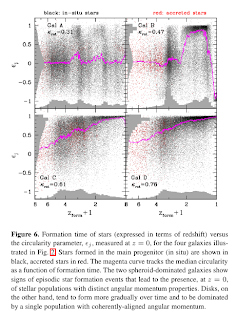 Gas accretion history is not the whole story. The authors claim that spin alignment of the accreted gas and the galaxy itself is more important: disks form when the two spin directions are similar, whereas spheroidals form when they are misaligned. Hot corona gas spends a lot of time inside the halo, it is forced to align its rotation with that of the halo and the galaxy itself. Spheroids form when a galaxy accretes a lot of cold gas via misaligned filaments, i.e. when the angular momenta of the galaxy and the gas are not aligned. Star formation in spheroidals proceeds in a bursty manner (due to a different channel of gas acquisition, not the slow and gradual corona gas accretion), leaving behind stars with different ages and angular momenta. Intermediate galaxies form when the spins are aligned, but the gas accreted is mostly cold.
The kinematic (at least) morphology is determined by the interplay of these two factors: in order to form a disk, a galaxy needs to have a lot of shock-heated gas in its corona, unless the spin misalignment between the spins the galaxy and the gas is too large. That may be only a part of the whole picture, as mergers may play a more important role in other mass ranges, they mention halo triaxiality and feedback as other potential factors of morphology. I think it is an interesting article, even if not directly related to TF. It reasserts what I had repeatedly heard in Jerusalem: that inflows and outflows are very important, and we do not know much about them. The results may be tested observationally: would it be possible to do something like fig.6 with CALIFA data?
Authors:Sales, Navarro et al.
Year:2012, http://arxiv.org/abs/1112.2220
I picked this article because it challenges the standard idea of galaxy formation I had always been taught: that disks were assembled quite recently in rotating, quiescent haloes, whereas spheroidals are results of mergers (or primordial collapse, as my supervisor pointed out). In other words, current morphology is strongly dependent on the assembly history of the haloes.
They use GIMIC simulations I wrote about to obtain a sizeable sample of Milky Way mass range galaxies. Using a kinematic morphology criterion (\kappa_rot, the fraction of kinetic energy corresponding to the ordered rotation, they look for the origin of morphology of a given galaxy. Simulations show that disks can be formed in haloes of high and low spin parameter (Bullock 2001), in haloes that collapse early or late, in haloes that go through merger events.
They find that disks are preferably formed by slow accretion of gas from a hot corona, as opposed to cold flows (many people in Jerusalem claimed those were important at high redshift). Disks assemble slowly and gradually (see fig.6: A galaxy is a spheroid, D galaxy is a disk, BC -- intermediate steps), and hot corona gas accretion might explain that.
 Gas accretion history is not the whole story. The authors claim that spin alignment of the accreted gas and the galaxy itself is more important: disks form when the two spin directions are similar, whereas spheroidals form when they are misaligned. Hot corona gas spends a lot of time inside the halo, it is forced to align its rotation with that of the halo and the galaxy itself. Spheroids form when a galaxy accretes a lot of cold gas via misaligned filaments, i.e. when the angular momenta of the galaxy and the gas are not aligned. Star formation in spheroidals proceeds in a bursty manner (due to a different channel of gas acquisition, not the slow and gradual corona gas accretion), leaving behind stars with different ages and angular momenta. Intermediate galaxies form when the spins are aligned, but the gas accreted is mostly cold.
The kinematic (at least) morphology is determined by the interplay of these two factors: in order to form a disk, a galaxy needs to have a lot of shock-heated gas in its corona, unless the spin misalignment between the spins the galaxy and the gas is too large. That may be only a part of the whole picture, as mergers may play a more important role in other mass ranges, they mention halo triaxiality and feedback as other potential factors of morphology. I think it is an interesting article, even if not directly related to TF. It reasserts what I had repeatedly heard in Jerusalem: that inflows and outflows are very important, and we do not know much about them. The results may be tested observationally: would it be possible to do something like fig.6 with CALIFA data?
Thursday, May 30, 2013
Daily Papers TODO: a collection of links
I'll be keeping the list of papers I want to read here.
Stellar Mass-to-Light Ratios and the Tully-Fisher Relation 3D Spectroscopy with VLT/GIRAFFE - IV: Angular Momentum and Dynamical Support of Intermediate Redshift Galaxies
ANGULAR MOMENTUM ACQUISITION IN GALAXY HALOS
The Baryonic TF relation -- we've discussed it before, but I need to write it up.
Stellar Mass-to-Light Ratios and the Tully-Fisher Relation 3D Spectroscopy with VLT/GIRAFFE - IV: Angular Momentum and Dynamical Support of Intermediate Redshift Galaxies
ANGULAR MOMENTUM ACQUISITION IN GALAXY HALOS
The Baryonic TF relation -- we've discussed it before, but I need to write it up.
Subscribe to:
Posts (Atom)