Showing posts with label star formation. Show all posts
Showing posts with label star formation. Show all posts
Tuesday, December 17, 2013

Tuesday, June 4, 2013
Daily Paper #11: The Origin of Disks and Spheroids in Simulated Galaxies
Title: The Origin of Disks and Spheroids in Simulated Galaxies
Authors:Sales, Navarro et al.
Year:2012, http://arxiv.org/abs/1112.2220
I picked this article because it challenges the standard idea of galaxy formation I had always been taught: that disks were assembled quite recently in rotating, quiescent haloes, whereas spheroidals are results of mergers (or primordial collapse, as my supervisor pointed out). In other words, current morphology is strongly dependent on the assembly history of the haloes.
They use GIMIC simulations I wrote about to obtain a sizeable sample of Milky Way mass range galaxies. Using a kinematic morphology criterion (\kappa_rot, the fraction of kinetic energy corresponding to the ordered rotation, they look for the origin of morphology of a given galaxy. Simulations show that disks can be formed in haloes of high and low spin parameter (Bullock 2001), in haloes that collapse early or late, in haloes that go through merger events.
They find that disks are preferably formed by slow accretion of gas from a hot corona, as opposed to cold flows (many people in Jerusalem claimed those were important at high redshift). Disks assemble slowly and gradually (see fig.6: A galaxy is a spheroid, D galaxy is a disk, BC -- intermediate steps), and hot corona gas accretion might explain that.
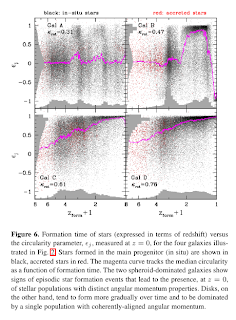 Gas accretion history is not the whole story. The authors claim that spin alignment of the accreted gas and the galaxy itself is more important: disks form when the two spin directions are similar, whereas spheroidals form when they are misaligned. Hot corona gas spends a lot of time inside the halo, it is forced to align its rotation with that of the halo and the galaxy itself. Spheroids form when a galaxy accretes a lot of cold gas via misaligned filaments, i.e. when the angular momenta of the galaxy and the gas are not aligned. Star formation in spheroidals proceeds in a bursty manner (due to a different channel of gas acquisition, not the slow and gradual corona gas accretion), leaving behind stars with different ages and angular momenta. Intermediate galaxies form when the spins are aligned, but the gas accreted is mostly cold.
The kinematic (at least) morphology is determined by the interplay of these two factors: in order to form a disk, a galaxy needs to have a lot of shock-heated gas in its corona, unless the spin misalignment between the spins the galaxy and the gas is too large. That may be only a part of the whole picture, as mergers may play a more important role in other mass ranges, they mention halo triaxiality and feedback as other potential factors of morphology. I think it is an interesting article, even if not directly related to TF. It reasserts what I had repeatedly heard in Jerusalem: that inflows and outflows are very important, and we do not know much about them. The results may be tested observationally: would it be possible to do something like fig.6 with CALIFA data?
Authors:Sales, Navarro et al.
Year:2012, http://arxiv.org/abs/1112.2220
I picked this article because it challenges the standard idea of galaxy formation I had always been taught: that disks were assembled quite recently in rotating, quiescent haloes, whereas spheroidals are results of mergers (or primordial collapse, as my supervisor pointed out). In other words, current morphology is strongly dependent on the assembly history of the haloes.
They use GIMIC simulations I wrote about to obtain a sizeable sample of Milky Way mass range galaxies. Using a kinematic morphology criterion (\kappa_rot, the fraction of kinetic energy corresponding to the ordered rotation, they look for the origin of morphology of a given galaxy. Simulations show that disks can be formed in haloes of high and low spin parameter (Bullock 2001), in haloes that collapse early or late, in haloes that go through merger events.
They find that disks are preferably formed by slow accretion of gas from a hot corona, as opposed to cold flows (many people in Jerusalem claimed those were important at high redshift). Disks assemble slowly and gradually (see fig.6: A galaxy is a spheroid, D galaxy is a disk, BC -- intermediate steps), and hot corona gas accretion might explain that.
 Gas accretion history is not the whole story. The authors claim that spin alignment of the accreted gas and the galaxy itself is more important: disks form when the two spin directions are similar, whereas spheroidals form when they are misaligned. Hot corona gas spends a lot of time inside the halo, it is forced to align its rotation with that of the halo and the galaxy itself. Spheroids form when a galaxy accretes a lot of cold gas via misaligned filaments, i.e. when the angular momenta of the galaxy and the gas are not aligned. Star formation in spheroidals proceeds in a bursty manner (due to a different channel of gas acquisition, not the slow and gradual corona gas accretion), leaving behind stars with different ages and angular momenta. Intermediate galaxies form when the spins are aligned, but the gas accreted is mostly cold.
The kinematic (at least) morphology is determined by the interplay of these two factors: in order to form a disk, a galaxy needs to have a lot of shock-heated gas in its corona, unless the spin misalignment between the spins the galaxy and the gas is too large. That may be only a part of the whole picture, as mergers may play a more important role in other mass ranges, they mention halo triaxiality and feedback as other potential factors of morphology. I think it is an interesting article, even if not directly related to TF. It reasserts what I had repeatedly heard in Jerusalem: that inflows and outflows are very important, and we do not know much about them. The results may be tested observationally: would it be possible to do something like fig.6 with CALIFA data?
Wednesday, May 15, 2013
Daily Paper #6: A physical model of cosmological simulations of galaxy formation
I picked this article for the group meeting presentation, and actually read it, because it is rather relevant.
Title: A physical model of cosmological simulations of galaxy formation
Authors: Vogelsberger, Genel, Sijacki et al.
Year: 2012, http://arxiv.org/pdf/1305.2913v1.pdf
They present galaxy formation simulations using the AREPO code, which is a moving mesh hydro code, claimed to combine the advantages of SPH and semi-analytical models built on top of N-body simulations. What is important, however, is that they include, among other things:
-- BH seeding and growth
-- 3 modes of AGN feedback (thermal, kinetic (radio jets) and EM radiation). The discrepancy between the high-mass end of McCarthy, Schaye et al. TFR and observations I discussed yesterday is probably due to lack of AGN feedback prescriptions.
-- realistic cooling (including metals) with self-shielding
-- realistic enrichment timescales and yields
-- different modes of outflows
The article itself is quite long and rather technical, dealing with the details of the implementation of physics. However, there are some interesting observations. For instance, they discuss the stellar mass function and its relation to feedback, halo mass function and the cosmic SFH. The stellar mass function is 'chewed' by stellar feedback (SN and stellar winds) at the low halo mass end, and by AGN feedback at the higher mass end. It can be viewed as the convolution of the halo mass function with the efficiency with which stars form in these haloes (i.e. feedback mechanisms).
I think this relation is really important -- actually, it shows why the TFR exists, and why there is a knee at the high-mass end. _Why_ the slope, zeropoint and scatter are such are different questions -- but the answer to that should be some combination of the halo concentration (i.e. response to baryons, mostly), details of feedback (which determine the shape of the M* -- Mhalo relation) and the initial halo mass function (i.e. cosmology). The latter also sets the angular momentum of galaxies (Vvir -- Mvir are related, see the description of Dutton 2011).
They reproduce the stellar mass-halo relation, stellar mass function, evolution of the cosmic SFR density, the cosmic stellar mass density, mass-metallicity relation, SDSS luminosity function, M_BH -- M* relation and the Tully-Fisher relation (in the Vcirc -- M* sense, see the other attached plot). They claim (by citing McCarthy & Schaye, and experimenting with different radii) that the precise radius of the velocity measurement is not very important.
They conclude that TFR is not very sensitive to feedback parameters (shown in the plot). However, feedback must be included, otherwise it is not possible to reproduce TFR correctly. They find that the stellar mass in a halo is primarily set by the stellar feedback and radio-mode AGN feedback.
Tuesday, May 14, 2013
Daily Paper #3: Rotation rates, sizes and star formation efficiencies of a representative population of simulated disc galaxies
I was a bit late today, because I went to see a couple of talks at the HETDEX meeting. A couple of interesting points from there:
-- The LAE people are worried about selection bias arising due to galaxy spins' alignment with the large scale structure (http://arxiv.org/abs/1004.3611)
-- Cluster growth depends not only on the proto-cluster environment (i.e. the immediate neighbourhood), but on super-halo scales as well (it's probably better defined here: http://arxiv.org/abs/1109.6328)
...On to the paper:
Title: Rotation rates, sizes and star formation efficiencies of a representative population of simulated disc galaxies
Authors: McCarthy, Schaye et al.
Year: 2012, http://arxiv.org/abs/1204.5195 They use resimulated (SPH) Millenium sub-regions with selected representative mean densities, including baryonic physics. They include background UV/Xray radiation field that 'reionises' the simulations at z = 9 and the CMB. They model star formation using an effective prescription reproducing the Kennicut's relation and assuming Chabrier IMF, as well as yields and timing of nucleosynthesis and SN feedback.
Then they fit the surface brightness profiles of galaxies in 9 - 11.5 log M* range with a Sersic function and classify their galaxies into disc and spheroid-dominated usin n = 2.5 as the cut.
-- The stellar mass - rotation velocity relation:
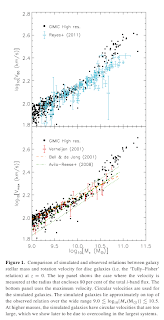 They examine this relation for their disk galaxy population (see the attached picture) and compare it with Reyes 2011 observations, claiming that this is the first cosmological hydrodynamical simulation that produces a population of galaxies consistent with the observed TFR. The slope is slightly higher, but in general, the agreement is really good. They use v80 (velocity at 80% light radius) and Vmax as the velocity measures. The velocities at their high-mass range are too big, and they claim that lack of prescription for AGN feedback may explain that.
The authors also discuss the scatter in TF relation, claiming that it is not possible to directly compare observed and simulated TF scatter without careful analysis of selection criteria and observational uncertainties.
Simulated spheroid galaxies follow the TFR well at this mass range, except for the most massive galaxies. The rotation curves of the galaxies with M* > 10.6 are not realistic (due to overcooling, too efficient SF of the highest mass haloes). Their simulated galaxies are also compatible with observed M* - size and star formation efficiency -- M* relations, up to the higher mass range.
One more quantity that simulations are compared with is the ratio of v_circ to v_200. If there is no significant halo expansion/contraction, this ratio should be roughly equal to 1.2 (Duffy 2010 writes more on halo expansion/contraction issue and impact on this ratio). Again, their results agree with this quite well up to log(M*) > 10.5.
They try to reproduce the main galaxy sequence at z = 0, comparing their results with SFR from Galex. Except for the lowest mass galaxies where their resolution is too small, it works well.
The section 4 is an interesting discussion of connection between SF efficiency, stellar mass function and the TF relation. They show that by assuming power-law shapes for halo mass function and stellar mass function in certain stellar mass range where this is valid, it is possible to match haloes (=velocities) and stellar masses using the abundance matching method, and reproduce TFR and SFR efficiency-M200 relations well (and maybe even constrain the faint end of the IMF). The way I understand it, the TFR arises due to the linear (in log-space) match between the halo mass function (set by cosmology) and the stellar mass function (set by IMF, SFR efficiency, thus feedback, etc.). I'll read Mo, van den Bosch and White 2010 for more discussion on this matter.
-- The LAE people are worried about selection bias arising due to galaxy spins' alignment with the large scale structure (http://arxiv.org/abs/1004.3611)
-- Cluster growth depends not only on the proto-cluster environment (i.e. the immediate neighbourhood), but on super-halo scales as well (it's probably better defined here: http://arxiv.org/abs/1109.6328)
...On to the paper:
Title: Rotation rates, sizes and star formation efficiencies of a representative population of simulated disc galaxies
Authors: McCarthy, Schaye et al.
Year: 2012, http://arxiv.org/abs/1204.5195 They use resimulated (SPH) Millenium sub-regions with selected representative mean densities, including baryonic physics. They include background UV/Xray radiation field that 'reionises' the simulations at z = 9 and the CMB. They model star formation using an effective prescription reproducing the Kennicut's relation and assuming Chabrier IMF, as well as yields and timing of nucleosynthesis and SN feedback.
Then they fit the surface brightness profiles of galaxies in 9 - 11.5 log M* range with a Sersic function and classify their galaxies into disc and spheroid-dominated usin n = 2.5 as the cut.
-- The stellar mass - rotation velocity relation:
 They examine this relation for their disk galaxy population (see the attached picture) and compare it with Reyes 2011 observations, claiming that this is the first cosmological hydrodynamical simulation that produces a population of galaxies consistent with the observed TFR. The slope is slightly higher, but in general, the agreement is really good. They use v80 (velocity at 80% light radius) and Vmax as the velocity measures. The velocities at their high-mass range are too big, and they claim that lack of prescription for AGN feedback may explain that.
The authors also discuss the scatter in TF relation, claiming that it is not possible to directly compare observed and simulated TF scatter without careful analysis of selection criteria and observational uncertainties.
Simulated spheroid galaxies follow the TFR well at this mass range, except for the most massive galaxies. The rotation curves of the galaxies with M* > 10.6 are not realistic (due to overcooling, too efficient SF of the highest mass haloes). Their simulated galaxies are also compatible with observed M* - size and star formation efficiency -- M* relations, up to the higher mass range.
One more quantity that simulations are compared with is the ratio of v_circ to v_200. If there is no significant halo expansion/contraction, this ratio should be roughly equal to 1.2 (Duffy 2010 writes more on halo expansion/contraction issue and impact on this ratio). Again, their results agree with this quite well up to log(M*) > 10.5.
They try to reproduce the main galaxy sequence at z = 0, comparing their results with SFR from Galex. Except for the lowest mass galaxies where their resolution is too small, it works well.
The section 4 is an interesting discussion of connection between SF efficiency, stellar mass function and the TF relation. They show that by assuming power-law shapes for halo mass function and stellar mass function in certain stellar mass range where this is valid, it is possible to match haloes (=velocities) and stellar masses using the abundance matching method, and reproduce TFR and SFR efficiency-M200 relations well (and maybe even constrain the faint end of the IMF). The way I understand it, the TFR arises due to the linear (in log-space) match between the halo mass function (set by cosmology) and the stellar mass function (set by IMF, SFR efficiency, thus feedback, etc.). I'll read Mo, van den Bosch and White 2010 for more discussion on this matter.
Monday, January 14, 2013
Jerusalem WS lecture notes: 16. Signatures of Inflows and Outflows
By R. Dave, slides here.
- metals in diffuse IGM -- outflows!
- at high z, SF can't keep up with inflow: the gas accumulation phase: gas can even turn into molecular phase, but due to low efficiency it won't all be processed into stars (equilibrium breaks down), RD 2012
- eta scaling ~ M_{halo} ^{-1/3} -- z_{equil} ~ 5 for massive galaxies
- equilibrium model code at http://ursa.as.arizona.edu/~/rad/work/equil.c
- 'thesis back in the stone age'
- constraining outflow parameters: direct observation and direct modelling are challenging
- direct observation of preventive feedback:
- mass in CGM: gas in absorption, X-ray emission, soft X-ray bg: COS (Cosmic Origins Spectrograph): OVI high ionisation line, 2 components: photo- and collisional excitation: SF galaxies are probing 300 000 K gas: http://sci.esa.int/science-e/www/object/index.cfm?fobjectid=49663, Anderson 2012
- direct observations of ejective feedback: outflowing ISM lines: LBG tomography
- direct observations of wind recycling: _metallicity_ of inflowing gas. Disk outskirts: \alpha_z ~ 0.3
- indirect constraints:
- counting statistics are not as good as scaling relations
- galaxies to 0th order are a 1-parameter family (stellar or halo mass) --> good scaling parameters
- conversion efficiency peaks at 10^{12} M_{\odot}
- if you don't have winds, you have overcooling problems
- cosmic SFR efficiency: SFR vs. Halo mass infall rate: a simple combination of model parameters (Behroozi et al), simulations are hard
- SFR vs. M_{\odot}: galaxy MS is the parameter to compare SF galaxies across redshifts, not SFR -- present starbursts and past normal SF galaxies have identical SFRs
- MS evolution is currently difficult to model
- SFR -- metallicity relation
- M_{star} -- feedback relation
- M_{star} function -- Baldry 2008 simulations -- reproduces the lower mass GSMF well, arbitrary quenching at logM > 11, governed by differential recycling which flattens the relation at intermediate masses --> inflection
- gas fractions and X_{co}
- DLAs: kinematics favor ejection, not prevention, CDM has many low-mass halos, if they have many HI, too many narrow DLAs result
Jerusalem WS lecture notes: 15. Star-Forming Galaxies
By R. Genzel, slides here
- ways to look back in time:
- look-back imaging surveys
- local stellar archaeology
- detailed, resolved in situ observations
- pathologies: Hanny's Voorwerp: radiation echo --> timescales of AGN evolution
- SF in MW:
- shielded regions, pressure comparable to diffuse ISM, density far above MW mean
- highly structured, velocity dispersion ~5 km/s (supersonic motions), increases with scale
- unstable to fragmentation
- in large scales -- virialised, in small scales -- not --> inefficient SF:
- MW SFR ~ 3 M_{\odot}/yr
- Krumholz 2005
- gas depletion time way smaller than Hubble time -- why stars are still forming: MHD pressure (Alfven) prevents collapse, GMCs are magnetically supercritical, but highly supersonic --> theory and observations tend to support the second explanation
- SF occurs in clusters (70-90%, Lada & Lada 1993), super star clusters with M ~ 10^6 M_{\odot} -- from the collapse of the whole MC
- SF tracers: Kennicutt 1998
- H\alpha: traces Lyman continuum, issues w/ extinction correction
- UV continuum: IR fine structure lines, C+ --> easily collisionally excited, in areas that are exposed to UV, OI line
- mid and far IR: calorimetric method: UV heats dust, reprocessing: FIR is currently the best, esp. due to Herschel
- radio: FIR-radio relation, works if there is no AGN, evolutionary changes
- SFH uncertainties: SF tracers are no better than 0.3 dex
- pictures of extinction:
- 'screen' of dust and gas surrounding SF region
- 'mixed' -- dust and stars are mixed, high and low exctinction regions: you can observe short and high wavelengths together, Calzetti 2000
- dust extinction: 'greyer' -- less dependent on wavelength
- mass tracers (see the slides):
- SED fitting: live stellar mass
- rotcurves: dynamical mass: HI not detectable beyond z = 0.1-0.2 until at least SKA
- velocity dispersion
- CO -- variation of X
- lensing
- submm dust luminosity (ALMA)
- uncertain up to at least factor of 2: SFH, IMF, extinction, spatial distribution, kinematics, conversion factors
- gas-SF formation:
- K-S relation (empirical, simple physical motivation (see slides)), Kennicutt & Evans 2012 review
- conversion factor: MW factor not appropriate for metal poor galaxies
- classic papers on SF: 'very good papers were written beyond our event horizon': Kenicutt 1983: infall required for SF over cosmic time
- spatially resolved SF relation: KS law between H_2 and SFR is more linear -- can we ignore HI?
- HCN traces very dense regions
- detection thresholds: stellar surface density
- KS relation breaks down in scales < 500 pc -- CO and H\alpha are not correlated, due to local evolutionary effects: larger areas are necessary to 'smear out'
- 'J. Gunn in suit'
- VLT: very thin, large mirror supported by adaptive optics pads
- LBT: thin faceplate on light honeycomb ceramic structure
- Concepts for > 20 m telescopes:
- aplanatic Gregorian optics
- 30 m telescope (TMT), EELT (10" FoV, 5 mirrors)
- JWST: 6m, 'Keck in space'
- AO:
- wavefront sensor
- deformable mirror
- guide star | artificial guide stars
- feedback w/ computer
- IFUs: KMOS
- mm interferometry of cold gas:
- IRAM Plateau de Bure -- exploration of molecular gas in high redshift
- ALMA: 0.005" resolution, R = 30 000000
Jerusalem WS notes: first part of student talks
A few notes, without credits.
- supersonic movement of DM and baryons at z > 10 -- effect on 21cm background, global history of 21 cm signal
- sSFR was surprisingly const b/ween 2 < z < 7 -- find rising sSFR with z
- a new generation of submm galaxies: Redhift survey of Herschel-selected starbursts: dusty super-luminous starbursts at z=2
- submm counts: flat IMF in bursts is required to match them, galaxy pairs contribution: look blended in SCUBA, resolved in ALMA: counts can be matched with standart IMF
- halo quenching -- high masses and z, bulge-related quenching: low z, low masses
- R_{vir} much smaller (2-3 times) than the extent of intercluster gas -- it's not the end of a cluster
- red-sequence fast track
- mass threshold of outflows
Jerusalem WS lecture notes: 11. The physics of stellar feedback
By M. Krumholz, the slides.
- 'conservative weed'
- Bate 2009 simulation -- SC formation. SF too efficient and fast -- SF efficiency close to 100%
- what inhibits SF? feedback:
- hot gas or photons push material away from the star, kinetic energy in the material shell = star energy output | radius set by momentum conservation (energy or momentum driven cases, radiation or winds). Mass in the shell way larger than the wind mass
- feedback budgets:
- Q -- radiant energy, wind energy, number of ionising photons
- IMF-averaged production rate: luminosity per unit mass (~M/L ratio)
- lifetime-weighted production rate -- energy out of unit mass (e.g. ergs/g)
- stochastic IMF sampling in dwarfs -- SLUG code
- galactic wind: at least as much mass as went into stars
- what feedbacks are interesting? those that can cause velocities higher than escape velocities --> lower limt
- losses: gravity, collisions (loss of momentum)
- ISM feedback taxonomy:
- ionising radiation: not important for galactic winds formation (sound speed ~10 km/s, so can influence in smaller MCs, Krumholz 2006, 2009, Dale 2012), probably the most important SF regulator today
- radiation pressure (photon momentum, Thompson scattering) -- ~200 km/s -- cannot be responsible for galactic winds, unless radiation enhancing fraction f_{trap} >> 1. Can be important for subgalactic objects, dwarf galaxies, can blow up gas clouds.
- the important question: what is the f_{trap}?:
- 30 Dor: dust grain temperature can help infer the IR radiation field, Lopez 2011
- simulations: 2D, high resoluton: RT instability -- similar to oil floating on water, right panel: no gravity, 2 different optical depths[surface densities]: RP may affect sub-galactic objects, but cannot produce galactic winds, Krumholz & Thompson 2013
- stellar winds: Solar wind is a wimpy old thing, O stars. Momentum driven
- 30 Dor -- most massive binary star system, each ~83 M_{\odot}, still on the MS
- supernovae: energy budget in stars of 8-10 M_{\odot}
- N_{SN}/M = 0.01 M_{odot}
- less energy and momentum than radiation feedback
- more energy, less momentum than winds
- SN are most important because they are much closer to energy conserving feedback -- large velocities, post-schock ejecta temperatures are ~10^{10} K --> cooling time is ~ 60 Myr, whereas time required to escape the galaxy is << 1 Myr, so gas cannot cool
- Sedov-Taylor similarity solution -- first developed for nuclear tests, open literature only in 1995 --> energy of Trinity blast from Time pictures (R_blast as a fn of time, Sedov), http://www.seas.harvard.edu/brenner/taylor/handouts/bomb/node1.html
- trapping factor ~30-40, momentum goes up by this factor during the energy conserving phase, density dependent: SNe explode in low density environments due to star radiation --> f_{trap} is elevated
- SNs can dominate momentum budget --> proper simulation should take other feedbacks into accounts
- metallicity feedback
- metallicity changes SF law (makes difference in dwarfs, high z galaxies) --> metallicity regulated SF (Kuhlen 2012 simulation), interactions wih other feedbacks
Wednesday, January 2, 2013
Jerusalem WS lecture notes: 09. the IMF and the SFR
By M. Krumholz, slides here. I especially liked Mark's lectures, because he wades into murky, difficult topics of the ISM physics that many researchers like to leave out and assume something.
- THE 2 problems
- IMF:
- determines stellar feedback (more at top-heavy IMF, etc), abundances, stellar masses
- Observations:
- Bastian 2010 -- MW MF plot http://arxiv.org/abs/1001.2965 -- universal IMF in different regions
- Why a typical star is a few 10ths M_{\odot}? Insensitive to SF environment, metallicity, dwarf/spiral galaxy type
- Andersen 2009: IMF in MCs (brightest HII region in the Local Group). Sabbi 2008: in SMC (0.2 Z_{\odot})
- Variation in cDs? van Dokkum & Conroy 2010 (unresolved stars, red & dead galaxies, stars formed at z = 2) -- http://www.nature.com/nature/journal/v468/n7326/abs/nature09578.html: "The direct detection of the light of low-mass stars implies that they are very abundant in elliptical galaxies, making up over 80% of the total number of stars and contributing more than 60% of the total stellar mass. We infer that the IMF in massive star-forming galaxies in the early Universe produced many more low-mass stars than the IMF in the Milky Way disk, and was probably slightly steeper than the Salpeter form in the mass range 0.1M_{\odot} to 1M_{\odot}"
- Peak location: non-isothermality is required, comes either from:
- galactic properties, e.g. Hopkins 2012
- local non-isothermality approximation:
- isothermality broken by star formation: accreting star is brighter than non-accreting star --> Krumholz 2012: the characteristic mass is set by deviation from isothermality due to SF, the characteristic mass (peak location) depends on pressure of the core (lower mass at higher p). Pressure is set by balance vs. gravity (surface density)
- Slope: universal, probably due to turbulence
- SFR:
- bathtub model (gas in, gas out) when t_{SF} << t_H
- Correlation b/ween molecular gas SD and SF on galactic scales
- sub-galactic scales: cloud mass vs. no of YSOs, IR luminosity vs. amount of gas (Wu 2005)
- Galaxy metallicity dependence
- phase dependence
- SFR is a function of Toomre Q in galaxy. Dobbs 2011 simulation: self-regulation
- Top-down model is not sufficient
- Bottom-up model: what matters is the small scales (local SF law)
- Why is \epsilon_{eff} (gas conversion to stars ratio) so low, ~1%? Federrath & Klessen 2012 --> few % efficiency for turbulent, virialised objects.
- l_s -- sound length, size scaling
- metallicity-phase dependence:
- why most of the gas is atomic? Dissociation by UV, except in areas where UV is shielded by dust or H_2, 'magic number' -- surface density that shields, ~10M_{\odot}/pc^2
- why SF follows H_2? Photons that are responsible for dissociation of H_2, are the same that heat the gas, so if the gas is shielded, it cools --> H_2
- extragalactic phase dependence (SMC has a different SF law because of different metallicity). SF is not only self-regulating process, it depends on global galaxy properties
Tuesday, January 1, 2013
Jerusalem WS lecture notes: 04. Physics of Star-Forming Clouds
By Mark Krumholz, 'the only obstacle between you and the exciting opportunity to combine drinking with jet lag'. Here are the slides.
Observations:
Observations:
- SF gas is cold: observations in radio, mm, far-IR
- Diffuse gas: emission lines, dust
- SF ISM is mostly molecular
- H_2: proof that nature has a cruel sense of humour:
no electronic excitation in cold gas, vibration: mid-IR energy, too high. Rotations: H2 has no dipole mode, no J1 -> J0 transitions, the lowest transition is J2 --> J0. J2 state -- 511 K off ground: no H2 molecules emission. - CO: proof that astronomers are stubborn bastards:
- If density is high, radiation doesn't change energy distribution (Boltzmann, collisions). Else: way fewer excited molecules than excpected, because collisions don't happen often.
- Brightness temperature
- Integrated CO intensity is measure of velocity dispersion (=total gravitating mass), if T = const.
- Intensity --> directly tells the column density (\Sigma) of CO and H2
- Motion in gas: bulk, non-thermal, highly supersonic
- Gas properties:
- cold (10K, 100K in starbursts): adiabatic compression, viscous dissipation, EUV ionisation/FUV photoelectric heating, CR/X ray heating, cooling processes: adiabatic expansion, lines. Dynamical timescales. CRs and X rays can penetrate high columns.
- Isothermal gas -- efficient cooling if the gas is compressed. Equilibrium T ~ 10K, hard to change. CR -- main source of heating.
- dense (n > 100cm^{-3})
- very supersonic: magnetic forces are important, extremely turbulent (Re ~ 10^9).
- linewidth-size relation (\sigma ~ size of the region), power spectrum
- VT: thermal motion/thermal pressure prevent collapse, Bonnor-Ebert mass: for a given pressure, there is a maximum mass that can be stable against collapse.
- for GMCs: M_{BE} ~= 10^7 M_{\odot}: that's why stars form in MCs.
Subscribe to:
Posts (Atom)