Trujillo-Gomez et al. 2011 -- Bolshoi resimulation also reproduces M-v_c relation.
Showing posts with label simulations. Show all posts
Showing posts with label simulations. Show all posts
Friday, November 29, 2013

Monday, November 18, 2013
lit: Tonini et al. 2013, on physically meaningful radius for velocity measurements
They define the 'corrected' disk scale-length that includes the bulge potential. Pay attention to this article anyway -- they add a dynamical classificator dimension to the TFR, which is a little bit akin to what I'm doing.
Thursday, November 7, 2013
Thursday, June 13, 2013
lit: Where do the dwarf galaxies go?
I've just attended a colloquium by J. Navarro of the NFW fame, which was really related to my current reading list. I'm writing an introductory chapter on hierarchical galaxy assembly for my thesis at the moment.
One unsolved problem of LCDM cosmology is the apparent lack of dwarf galaxies: simulations and statistical frameworks (such as EPS) predict that we should see a large number (hundreds) of dwarf galaxies around each bright galaxy such as the Milky Way, but we only know of a dozen. Same with Andromeda.
J. Navarro also showed some puzzling properties of local dwarfs, for example, the fact that their star formation histories are wildly different. Some formed all their gas 10 or so Gyr ago, some had a starburst recently, and some have double-peaked SFH's. He presented the work of his student which could explain it: the CLUES simulation shows that a combination of interaction with the collapsing cosmic web, mergers of dwarfs and reionisation stripping can in principle explain this. Some dwarfs lost their gas simply because they moved too fast through the cosmic web. The remainders of such galaxies may be just too faint for us to see.
One unsolved problem of LCDM cosmology is the apparent lack of dwarf galaxies: simulations and statistical frameworks (such as EPS) predict that we should see a large number (hundreds) of dwarf galaxies around each bright galaxy such as the Milky Way, but we only know of a dozen. Same with Andromeda.
J. Navarro also showed some puzzling properties of local dwarfs, for example, the fact that their star formation histories are wildly different. Some formed all their gas 10 or so Gyr ago, some had a starburst recently, and some have double-peaked SFH's. He presented the work of his student which could explain it: the CLUES simulation shows that a combination of interaction with the collapsing cosmic web, mergers of dwarfs and reionisation stripping can in principle explain this. Some dwarfs lost their gas simply because they moved too fast through the cosmic web. The remainders of such galaxies may be just too faint for us to see.
Tuesday, June 4, 2013
Daily Paper #11: The Origin of Disks and Spheroids in Simulated Galaxies
Title: The Origin of Disks and Spheroids in Simulated Galaxies
Authors:Sales, Navarro et al.
Year:2012, http://arxiv.org/abs/1112.2220
I picked this article because it challenges the standard idea of galaxy formation I had always been taught: that disks were assembled quite recently in rotating, quiescent haloes, whereas spheroidals are results of mergers (or primordial collapse, as my supervisor pointed out). In other words, current morphology is strongly dependent on the assembly history of the haloes.
They use GIMIC simulations I wrote about to obtain a sizeable sample of Milky Way mass range galaxies. Using a kinematic morphology criterion (\kappa_rot, the fraction of kinetic energy corresponding to the ordered rotation, they look for the origin of morphology of a given galaxy. Simulations show that disks can be formed in haloes of high and low spin parameter (Bullock 2001), in haloes that collapse early or late, in haloes that go through merger events.
They find that disks are preferably formed by slow accretion of gas from a hot corona, as opposed to cold flows (many people in Jerusalem claimed those were important at high redshift). Disks assemble slowly and gradually (see fig.6: A galaxy is a spheroid, D galaxy is a disk, BC -- intermediate steps), and hot corona gas accretion might explain that.
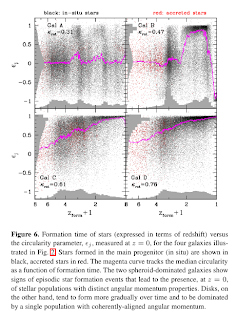 Gas accretion history is not the whole story. The authors claim that spin alignment of the accreted gas and the galaxy itself is more important: disks form when the two spin directions are similar, whereas spheroidals form when they are misaligned. Hot corona gas spends a lot of time inside the halo, it is forced to align its rotation with that of the halo and the galaxy itself. Spheroids form when a galaxy accretes a lot of cold gas via misaligned filaments, i.e. when the angular momenta of the galaxy and the gas are not aligned. Star formation in spheroidals proceeds in a bursty manner (due to a different channel of gas acquisition, not the slow and gradual corona gas accretion), leaving behind stars with different ages and angular momenta. Intermediate galaxies form when the spins are aligned, but the gas accreted is mostly cold.
The kinematic (at least) morphology is determined by the interplay of these two factors: in order to form a disk, a galaxy needs to have a lot of shock-heated gas in its corona, unless the spin misalignment between the spins the galaxy and the gas is too large. That may be only a part of the whole picture, as mergers may play a more important role in other mass ranges, they mention halo triaxiality and feedback as other potential factors of morphology. I think it is an interesting article, even if not directly related to TF. It reasserts what I had repeatedly heard in Jerusalem: that inflows and outflows are very important, and we do not know much about them. The results may be tested observationally: would it be possible to do something like fig.6 with CALIFA data?
Authors:Sales, Navarro et al.
Year:2012, http://arxiv.org/abs/1112.2220
I picked this article because it challenges the standard idea of galaxy formation I had always been taught: that disks were assembled quite recently in rotating, quiescent haloes, whereas spheroidals are results of mergers (or primordial collapse, as my supervisor pointed out). In other words, current morphology is strongly dependent on the assembly history of the haloes.
They use GIMIC simulations I wrote about to obtain a sizeable sample of Milky Way mass range galaxies. Using a kinematic morphology criterion (\kappa_rot, the fraction of kinetic energy corresponding to the ordered rotation, they look for the origin of morphology of a given galaxy. Simulations show that disks can be formed in haloes of high and low spin parameter (Bullock 2001), in haloes that collapse early or late, in haloes that go through merger events.
They find that disks are preferably formed by slow accretion of gas from a hot corona, as opposed to cold flows (many people in Jerusalem claimed those were important at high redshift). Disks assemble slowly and gradually (see fig.6: A galaxy is a spheroid, D galaxy is a disk, BC -- intermediate steps), and hot corona gas accretion might explain that.
 Gas accretion history is not the whole story. The authors claim that spin alignment of the accreted gas and the galaxy itself is more important: disks form when the two spin directions are similar, whereas spheroidals form when they are misaligned. Hot corona gas spends a lot of time inside the halo, it is forced to align its rotation with that of the halo and the galaxy itself. Spheroids form when a galaxy accretes a lot of cold gas via misaligned filaments, i.e. when the angular momenta of the galaxy and the gas are not aligned. Star formation in spheroidals proceeds in a bursty manner (due to a different channel of gas acquisition, not the slow and gradual corona gas accretion), leaving behind stars with different ages and angular momenta. Intermediate galaxies form when the spins are aligned, but the gas accreted is mostly cold.
The kinematic (at least) morphology is determined by the interplay of these two factors: in order to form a disk, a galaxy needs to have a lot of shock-heated gas in its corona, unless the spin misalignment between the spins the galaxy and the gas is too large. That may be only a part of the whole picture, as mergers may play a more important role in other mass ranges, they mention halo triaxiality and feedback as other potential factors of morphology. I think it is an interesting article, even if not directly related to TF. It reasserts what I had repeatedly heard in Jerusalem: that inflows and outflows are very important, and we do not know much about them. The results may be tested observationally: would it be possible to do something like fig.6 with CALIFA data?
Wednesday, May 22, 2013
Daily Paper #8: Constraints on the relationship between stellar mass and halo mass at low and high redshift
Title: Constraints on the relationship between stellar mass and halo mass at low and high redshift
Authors: Moster, Somerville et al.
Year: 2009, http://arxiv.org/abs/0903.4682
They give a nice breakdown of the methods used to link the halo properties with those of the galaxy. It is possible to obtain these relations from observations (kinematics, lensing, X-rays), from bottom-up modelling (N-body or SAMs), or by using a statistical approach: obtaining the probability that a halo with a certain mass hosts a certain number of galaxies with some certain properties (luminosity, type, etc.). This way, we don't have to make assumptions about feedback and other poorly-understood processes that plague the SAMs. I'll review the lecture recordings from Jerusalem School, I think the formalism used was explained in detail there.
The goal of this paper is to construct the conditional stellar mass function (as opposed to the conditional luminosity function). Such a function provides the average number of galaxies in a certain stellar mass range that reside in a halo with a mass M -- it can also be viewed as the stellar mass function for the haloes of mass M.
They use a N-body simulation to obtain a population of DM haloes and their merger tree information. The ratio of the halo mass M and the stellar mass M is not constant (due to different feedback processes), so they use a parameterisation of it to fill the haloes with galaxies, and obtain the stellar mass-Mhalo relation.
In order to obtain the conditional mass function, they divide the galaxies into centrals and satellites, parameterising their distribution in two different ways. The total CMF is the combination of the two.
They also obtain the M* -- M_halo relationship for higher redshifts, claiming that 'large halos accrete dark matter faster than large galaxies grow in stellar mass, while the growth of low mass halos is slower than that of the central galaxies they harbor', (see the attached picture).
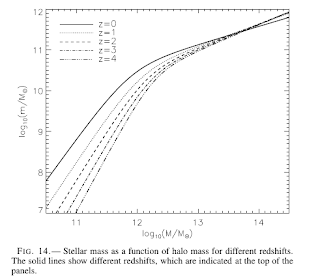
This paper does not mention the TF relation, however, I wanted to find out more about the M*-Mhalo relation, the ways to determine it and its evolution. It's interesting that the high-mass end of this relation does not evolve much since z=4.
Authors: Moster, Somerville et al.
Year: 2009, http://arxiv.org/abs/0903.4682
They give a nice breakdown of the methods used to link the halo properties with those of the galaxy. It is possible to obtain these relations from observations (kinematics, lensing, X-rays), from bottom-up modelling (N-body or SAMs), or by using a statistical approach: obtaining the probability that a halo with a certain mass hosts a certain number of galaxies with some certain properties (luminosity, type, etc.). This way, we don't have to make assumptions about feedback and other poorly-understood processes that plague the SAMs. I'll review the lecture recordings from Jerusalem School, I think the formalism used was explained in detail there.
The goal of this paper is to construct the conditional stellar mass function (as opposed to the conditional luminosity function). Such a function provides the average number of galaxies in a certain stellar mass range that reside in a halo with a mass M -- it can also be viewed as the stellar mass function for the haloes of mass M.
They use a N-body simulation to obtain a population of DM haloes and their merger tree information. The ratio of the halo mass M and the stellar mass M is not constant (due to different feedback processes), so they use a parameterisation of it to fill the haloes with galaxies, and obtain the stellar mass-Mhalo relation.
In order to obtain the conditional mass function, they divide the galaxies into centrals and satellites, parameterising their distribution in two different ways. The total CMF is the combination of the two.
They also obtain the M* -- M_halo relationship for higher redshifts, claiming that 'large halos accrete dark matter faster than large galaxies grow in stellar mass, while the growth of low mass halos is slower than that of the central galaxies they harbor', (see the attached picture).

This paper does not mention the TF relation, however, I wanted to find out more about the M*-Mhalo relation, the ways to determine it and its evolution. It's interesting that the high-mass end of this relation does not evolve much since z=4.
Wednesday, May 15, 2013
Daily Paper #6: A physical model of cosmological simulations of galaxy formation
I picked this article for the group meeting presentation, and actually read it, because it is rather relevant.
Title: A physical model of cosmological simulations of galaxy formation
Authors: Vogelsberger, Genel, Sijacki et al.
Year: 2012, http://arxiv.org/pdf/1305.2913v1.pdf
They present galaxy formation simulations using the AREPO code, which is a moving mesh hydro code, claimed to combine the advantages of SPH and semi-analytical models built on top of N-body simulations. What is important, however, is that they include, among other things:
-- BH seeding and growth
-- 3 modes of AGN feedback (thermal, kinetic (radio jets) and EM radiation). The discrepancy between the high-mass end of McCarthy, Schaye et al. TFR and observations I discussed yesterday is probably due to lack of AGN feedback prescriptions.
-- realistic cooling (including metals) with self-shielding
-- realistic enrichment timescales and yields
-- different modes of outflows
The article itself is quite long and rather technical, dealing with the details of the implementation of physics. However, there are some interesting observations. For instance, they discuss the stellar mass function and its relation to feedback, halo mass function and the cosmic SFH. The stellar mass function is 'chewed' by stellar feedback (SN and stellar winds) at the low halo mass end, and by AGN feedback at the higher mass end. It can be viewed as the convolution of the halo mass function with the efficiency with which stars form in these haloes (i.e. feedback mechanisms).
I think this relation is really important -- actually, it shows why the TFR exists, and why there is a knee at the high-mass end. _Why_ the slope, zeropoint and scatter are such are different questions -- but the answer to that should be some combination of the halo concentration (i.e. response to baryons, mostly), details of feedback (which determine the shape of the M* -- Mhalo relation) and the initial halo mass function (i.e. cosmology). The latter also sets the angular momentum of galaxies (Vvir -- Mvir are related, see the description of Dutton 2011).
They reproduce the stellar mass-halo relation, stellar mass function, evolution of the cosmic SFR density, the cosmic stellar mass density, mass-metallicity relation, SDSS luminosity function, M_BH -- M* relation and the Tully-Fisher relation (in the Vcirc -- M* sense, see the other attached plot). They claim (by citing McCarthy & Schaye, and experimenting with different radii) that the precise radius of the velocity measurement is not very important.
They conclude that TFR is not very sensitive to feedback parameters (shown in the plot). However, feedback must be included, otherwise it is not possible to reproduce TFR correctly. They find that the stellar mass in a halo is primarily set by the stellar feedback and radio-mode AGN feedback.
Title: A physical model of cosmological simulations of galaxy formation
Authors: Vogelsberger, Genel, Sijacki et al.
Year: 2012, http://arxiv.org/pdf/1305.2913v1.pdf
They present galaxy formation simulations using the AREPO code, which is a moving mesh hydro code, claimed to combine the advantages of SPH and semi-analytical models built on top of N-body simulations. What is important, however, is that they include, among other things:
-- BH seeding and growth
-- 3 modes of AGN feedback (thermal, kinetic (radio jets) and EM radiation). The discrepancy between the high-mass end of McCarthy, Schaye et al. TFR and observations I discussed yesterday is probably due to lack of AGN feedback prescriptions.
-- realistic cooling (including metals) with self-shielding
-- realistic enrichment timescales and yields
-- different modes of outflows
The article itself is quite long and rather technical, dealing with the details of the implementation of physics. However, there are some interesting observations. For instance, they discuss the stellar mass function and its relation to feedback, halo mass function and the cosmic SFH. The stellar mass function is 'chewed' by stellar feedback (SN and stellar winds) at the low halo mass end, and by AGN feedback at the higher mass end. It can be viewed as the convolution of the halo mass function with the efficiency with which stars form in these haloes (i.e. feedback mechanisms).
I think this relation is really important -- actually, it shows why the TFR exists, and why there is a knee at the high-mass end. _Why_ the slope, zeropoint and scatter are such are different questions -- but the answer to that should be some combination of the halo concentration (i.e. response to baryons, mostly), details of feedback (which determine the shape of the M* -- Mhalo relation) and the initial halo mass function (i.e. cosmology). The latter also sets the angular momentum of galaxies (Vvir -- Mvir are related, see the description of Dutton 2011).
They reproduce the stellar mass-halo relation, stellar mass function, evolution of the cosmic SFR density, the cosmic stellar mass density, mass-metallicity relation, SDSS luminosity function, M_BH -- M* relation and the Tully-Fisher relation (in the Vcirc -- M* sense, see the other attached plot). They claim (by citing McCarthy & Schaye, and experimenting with different radii) that the precise radius of the velocity measurement is not very important.
They conclude that TFR is not very sensitive to feedback parameters (shown in the plot). However, feedback must be included, otherwise it is not possible to reproduce TFR correctly. They find that the stellar mass in a halo is primarily set by the stellar feedback and radio-mode AGN feedback.
Tuesday, May 14, 2013
Daily Paper #3: Rotation rates, sizes and star formation efficiencies of a representative population of simulated disc galaxies
I was a bit late today, because I went to see a couple of talks at the HETDEX meeting. A couple of interesting points from there:
-- The LAE people are worried about selection bias arising due to galaxy spins' alignment with the large scale structure (http://arxiv.org/abs/1004.3611)
-- Cluster growth depends not only on the proto-cluster environment (i.e. the immediate neighbourhood), but on super-halo scales as well (it's probably better defined here: http://arxiv.org/abs/1109.6328)
...On to the paper:
Title: Rotation rates, sizes and star formation efficiencies of a representative population of simulated disc galaxies
Authors: McCarthy, Schaye et al.
Year: 2012, http://arxiv.org/abs/1204.5195 They use resimulated (SPH) Millenium sub-regions with selected representative mean densities, including baryonic physics. They include background UV/Xray radiation field that 'reionises' the simulations at z = 9 and the CMB. They model star formation using an effective prescription reproducing the Kennicut's relation and assuming Chabrier IMF, as well as yields and timing of nucleosynthesis and SN feedback.
Then they fit the surface brightness profiles of galaxies in 9 - 11.5 log M* range with a Sersic function and classify their galaxies into disc and spheroid-dominated usin n = 2.5 as the cut.
-- The stellar mass - rotation velocity relation:
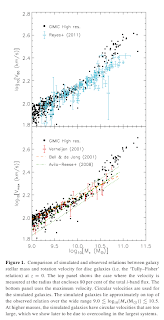 They examine this relation for their disk galaxy population (see the attached picture) and compare it with Reyes 2011 observations, claiming that this is the first cosmological hydrodynamical simulation that produces a population of galaxies consistent with the observed TFR. The slope is slightly higher, but in general, the agreement is really good. They use v80 (velocity at 80% light radius) and Vmax as the velocity measures. The velocities at their high-mass range are too big, and they claim that lack of prescription for AGN feedback may explain that.
The authors also discuss the scatter in TF relation, claiming that it is not possible to directly compare observed and simulated TF scatter without careful analysis of selection criteria and observational uncertainties.
Simulated spheroid galaxies follow the TFR well at this mass range, except for the most massive galaxies. The rotation curves of the galaxies with M* > 10.6 are not realistic (due to overcooling, too efficient SF of the highest mass haloes). Their simulated galaxies are also compatible with observed M* - size and star formation efficiency -- M* relations, up to the higher mass range.
One more quantity that simulations are compared with is the ratio of v_circ to v_200. If there is no significant halo expansion/contraction, this ratio should be roughly equal to 1.2 (Duffy 2010 writes more on halo expansion/contraction issue and impact on this ratio). Again, their results agree with this quite well up to log(M*) > 10.5.
They try to reproduce the main galaxy sequence at z = 0, comparing their results with SFR from Galex. Except for the lowest mass galaxies where their resolution is too small, it works well.
The section 4 is an interesting discussion of connection between SF efficiency, stellar mass function and the TF relation. They show that by assuming power-law shapes for halo mass function and stellar mass function in certain stellar mass range where this is valid, it is possible to match haloes (=velocities) and stellar masses using the abundance matching method, and reproduce TFR and SFR efficiency-M200 relations well (and maybe even constrain the faint end of the IMF). The way I understand it, the TFR arises due to the linear (in log-space) match between the halo mass function (set by cosmology) and the stellar mass function (set by IMF, SFR efficiency, thus feedback, etc.). I'll read Mo, van den Bosch and White 2010 for more discussion on this matter.
-- The LAE people are worried about selection bias arising due to galaxy spins' alignment with the large scale structure (http://arxiv.org/abs/1004.3611)
-- Cluster growth depends not only on the proto-cluster environment (i.e. the immediate neighbourhood), but on super-halo scales as well (it's probably better defined here: http://arxiv.org/abs/1109.6328)
...On to the paper:
Title: Rotation rates, sizes and star formation efficiencies of a representative population of simulated disc galaxies
Authors: McCarthy, Schaye et al.
Year: 2012, http://arxiv.org/abs/1204.5195 They use resimulated (SPH) Millenium sub-regions with selected representative mean densities, including baryonic physics. They include background UV/Xray radiation field that 'reionises' the simulations at z = 9 and the CMB. They model star formation using an effective prescription reproducing the Kennicut's relation and assuming Chabrier IMF, as well as yields and timing of nucleosynthesis and SN feedback.
Then they fit the surface brightness profiles of galaxies in 9 - 11.5 log M* range with a Sersic function and classify their galaxies into disc and spheroid-dominated usin n = 2.5 as the cut.
-- The stellar mass - rotation velocity relation:
 They examine this relation for their disk galaxy population (see the attached picture) and compare it with Reyes 2011 observations, claiming that this is the first cosmological hydrodynamical simulation that produces a population of galaxies consistent with the observed TFR. The slope is slightly higher, but in general, the agreement is really good. They use v80 (velocity at 80% light radius) and Vmax as the velocity measures. The velocities at their high-mass range are too big, and they claim that lack of prescription for AGN feedback may explain that.
The authors also discuss the scatter in TF relation, claiming that it is not possible to directly compare observed and simulated TF scatter without careful analysis of selection criteria and observational uncertainties.
Simulated spheroid galaxies follow the TFR well at this mass range, except for the most massive galaxies. The rotation curves of the galaxies with M* > 10.6 are not realistic (due to overcooling, too efficient SF of the highest mass haloes). Their simulated galaxies are also compatible with observed M* - size and star formation efficiency -- M* relations, up to the higher mass range.
One more quantity that simulations are compared with is the ratio of v_circ to v_200. If there is no significant halo expansion/contraction, this ratio should be roughly equal to 1.2 (Duffy 2010 writes more on halo expansion/contraction issue and impact on this ratio). Again, their results agree with this quite well up to log(M*) > 10.5.
They try to reproduce the main galaxy sequence at z = 0, comparing their results with SFR from Galex. Except for the lowest mass galaxies where their resolution is too small, it works well.
The section 4 is an interesting discussion of connection between SF efficiency, stellar mass function and the TF relation. They show that by assuming power-law shapes for halo mass function and stellar mass function in certain stellar mass range where this is valid, it is possible to match haloes (=velocities) and stellar masses using the abundance matching method, and reproduce TFR and SFR efficiency-M200 relations well (and maybe even constrain the faint end of the IMF). The way I understand it, the TFR arises due to the linear (in log-space) match between the halo mass function (set by cosmology) and the stellar mass function (set by IMF, SFR efficiency, thus feedback, etc.). I'll read Mo, van den Bosch and White 2010 for more discussion on this matter.
Monday, May 13, 2013
Daily Paper #2: The Tully-Fisher Zero Point Problem
Today's is a short paper (conference proceedings, just 4 or so pages), dealing with the halo contraction/expansion issue.
Title: The Tully-Fisher Zero Point Problem
Authors: Dutton, van den Bosch & Courteau
Year: 2008, http://arxiv.org/abs/0801.1505
The authors claim that CDM-based disk formation models can reproduce the slope/scatter of the TFR, however, its zeropoint has not been matched. This problem gets even worse if additional constraints (disk sizes, number densities) are imposed.
The TFR zeropoint can be matched in models if the halo contraction or disk self-gravity are not taken into account, or, as is shown in the article, halo contraction is counteracted by baryon feedback. They model an exponential disk in a NFW halo, obtain its luminosity from observed TFR and its scale-length from the size-luminosity relation. Assuming WMAP3 cosmology and a concentration parameter value from simulations, they solve for the virial mass and obtain rotation curves with and without the halo contraction (see the attached plot). The halo-contraction case is in conflict with both theory and observations, meaning that the halo is too small and has too high spin parameter.
They suggest 3 ways to solve this problem:
Title: The Tully-Fisher Zero Point Problem
Authors: Dutton, van den Bosch & Courteau
Year: 2008, http://arxiv.org/abs/0801.1505
The authors claim that CDM-based disk formation models can reproduce the slope/scatter of the TFR, however, its zeropoint has not been matched. This problem gets even worse if additional constraints (disk sizes, number densities) are imposed.
The TFR zeropoint can be matched in models if the halo contraction or disk self-gravity are not taken into account, or, as is shown in the article, halo contraction is counteracted by baryon feedback. They model an exponential disk in a NFW halo, obtain its luminosity from observed TFR and its scale-length from the size-luminosity relation. Assuming WMAP3 cosmology and a concentration parameter value from simulations, they solve for the virial mass and obtain rotation curves with and without the halo contraction (see the attached plot). The halo-contraction case is in conflict with both theory and observations, meaning that the halo is too small and has too high spin parameter.
They suggest 3 ways to solve this problem:
- -- lower the stellar mass-to-light ratio (but there is no known IMF that could provide that). Also, they claim that baryons at the disk and bulge account for at least half of the v2.2 -- I didn't know that (Courteau 1999, Weiner 2001)!
- -- lower the initial concentration (then the virial radius of a halo is increased) -- but that's incompatible with WMAP3 cosmology.
-
-- turn off or reverse halo contraction: disk galaxies do not form in isolated haloes by smooth cooling. Halo contraction can be reversed by:
- a) Feedback during adiabatic disk formation, if a large fraction of its mass is removed. It would also explain why galaxy formation is so inefficient (I think they mean that the gas is not converted into stars rapidly).
- b) Dynamic friction between baryons and DM due to bars or large baryonic clumps (do they mean violent disk instabilities here?). They do not explain the details of such a process here, but I think what happens is that baryons transfer some of their angular momentum to the halo due to formation of massive, concentrated, rapidly moving structures.
Friday, May 10, 2013
Daily Paper: The formation of galactic discs
Me and my supervisor agreed that I would read a paper a day and write it up, so I'll be copying the summaries here.
Title: The formation of galactic discs (http://adsabs.harvard.edu/abs/1998MNRAS.295..319M)
Authors: Mo, Mao, White
Year: 1998
It's actually a really important paper -- I'm glad not to have missed it. They model galactic disk formation (of pure exponential ones, though they address influence of a simple bulge model later) in 3 CDM cosmologies. The authors make 4 important assumptions:
1) The mass of a disk is a fixed fraction of its halo
2) The angular momentum of the disk is also a fixed fraction of that of the DM halo (later they find that the specific angular momenta of the disk and halo are similar, so these two ratios should be equal).
3) The disk is thin, has an exponential density profile and is centrifugally supported
4) Real galaxies are dynamically stable disks, i.e. they reject unstable models.
They calculate the halo mass function using Press-Schechter formalism (see Appendix), assume halo angular momentum distribution determined by N-body simulations and a constant mass-to light ratio, and NFW profile. They calculate the total energy of a truncated (to r_200) NFW halo using the virial theorem, the rotation curve corresponding to it (after accounting for adiabatic halo contraction and gravitational disk influence).
See the attached picture (Mo1998_rotcurves.png) for their results. They claim that the shape of a rotation curve depends on 3 parameters only: the halo concentration parameter c(see *), fraction of mass in the disk m_d, and the spin parameter.
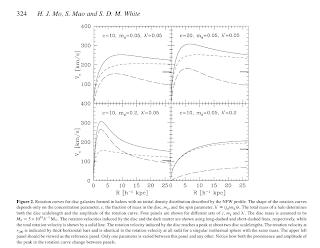
There is a lot more in this paper, but they devote a significant section of it to Tully-Fisher relation, explaining the origins of its slope, zeropoint and intrinsic scatter.
The intrinsic scatter because of the first two factors cannot be smaller than 0.15 mag.
In conclusion, they show that it is possible to derive a realistic TF relation theoretically, however, I'm not sure if that is the only way it could arise? They do not include bulges, which are important for our sample, too. I am also unsure what do they mean with 'effective disk assembly redshift' at z <= 1.
* c == r_200/r_s, here r_200 -- the limiting radius of a halo, defined so that the mean density inside this radius is 200 times larger than the background density, r_s -- the disk scale length.
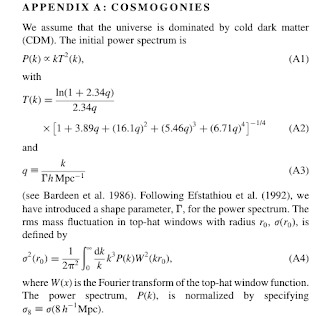
There is also a brief explanation of the \sigma_8 parameter -- see attached.
Title: The formation of galactic discs (http://adsabs.harvard.edu/abs/1998MNRAS.295..319M)
Authors: Mo, Mao, White
Year: 1998
It's actually a really important paper -- I'm glad not to have missed it. They model galactic disk formation (of pure exponential ones, though they address influence of a simple bulge model later) in 3 CDM cosmologies. The authors make 4 important assumptions:
1) The mass of a disk is a fixed fraction of its halo
2) The angular momentum of the disk is also a fixed fraction of that of the DM halo (later they find that the specific angular momenta of the disk and halo are similar, so these two ratios should be equal).
3) The disk is thin, has an exponential density profile and is centrifugally supported
4) Real galaxies are dynamically stable disks, i.e. they reject unstable models.
They calculate the halo mass function using Press-Schechter formalism (see Appendix), assume halo angular momentum distribution determined by N-body simulations and a constant mass-to light ratio, and NFW profile. They calculate the total energy of a truncated (to r_200) NFW halo using the virial theorem, the rotation curve corresponding to it (after accounting for adiabatic halo contraction and gravitational disk influence).
See the attached picture (Mo1998_rotcurves.png) for their results. They claim that the shape of a rotation curve depends on 3 parameters only: the halo concentration parameter c(see *), fraction of mass in the disk m_d, and the spin parameter.

There is a lot more in this paper, but they devote a significant section of it to Tully-Fisher relation, explaining the origins of its slope, zeropoint and intrinsic scatter.
- -- slope: They claim that it is a generic prediction of hierarchical structure formation models with CDM-like fluctuation spectra (which set the halo formation times and thus their concentration c distribution).
- -- zeropoint: mostly set on disk mass fraction, mass-to-light radio and the redshift at which a given disk was assembled. They claim that disks must have effectively formed at redshifts close to zero (?), unless we assume an unphysical mass-to-light ratio.
- -- scatter: they analyse possible sources of intrinsic scatter of the disks, and find that:
- --- a small amount of scatter comes from the spin parameter distribution
- --- scatter in concentration c also adds scatter to the TF relation (disks at more concentrated haloes spin faster).
- --- bulge is not included in their model, so bulge luminosity contribution is not accounted for -- that's a source of scatter as well
- --- mass-to-light ratio may vary, adding some more scatter
- --- formation times may vary as well, adding even more scatter.
The intrinsic scatter because of the first two factors cannot be smaller than 0.15 mag.
In conclusion, they show that it is possible to derive a realistic TF relation theoretically, however, I'm not sure if that is the only way it could arise? They do not include bulges, which are important for our sample, too. I am also unsure what do they mean with 'effective disk assembly redshift' at z <= 1.
* c == r_200/r_s, here r_200 -- the limiting radius of a halo, defined so that the mean density inside this radius is 200 times larger than the background density, r_s -- the disk scale length.
There is also a brief explanation of the \sigma_8 parameter -- see attached.

Tuesday, April 30, 2013
lit: J. Primack lectures on semi-analytic galaxy models and feedback
Lecture notes about quenching, feedback, SAMs. Includes a nice image of the 'star forming band'.
Thursday, April 25, 2013
lit: Spins and orientations of haloes in cosmic filaments
Zhang et al., many useful references on methods therein.
Subscribe to:
Posts (Atom)