The covariance matrix is N-dimensional generalisation of the scalar variance in 1 dimension. Here's a simple explanation of it which I needed in order to code up a test case for fitting a 2D Gaussian with intrinsic scatter.
Showing posts with label scaling relations. Show all posts
Showing posts with label scaling relations. Show all posts
Thursday, December 5, 2013

Friday, November 29, 2013
lit: Galaxies in LCDM with halo abundance matching
Trujillo-Gomez et al. 2011 -- Bolshoi resimulation also reproduces M-v_c relation.
Thursday, November 21, 2013
lit: Velocity dispersions and dynamical masses for a large sample of quiescent galaxies at z>1
By Belli et al. They show that the stellar-dynamical mass ratio for massive ellipticals was in place at z > 1.

Wednesday, November 20, 2013
lit: Yegorova et al. 2007
A detailed investigation of the dependence of the slope of TFR on the radius where the velocity is measured. They find that the scatter is smallest at R = 0.6 R_opt (see fig.5).
Wednesday, September 25, 2013
lit: Precise TFRs without galaxy inclinations
Precise TFRs without galaxy inclinations, by Obreschkow et al. A really interesting read about why photometric (axis ratio-based) inclination values are not optimal, what TFR is good for, fitting the TFR, etc. The main point of the article is recovering the TFR for samples with limited or no inclination data, but I haven't read it in detail yet.
Monday, August 26, 2013
Fitting the Tully-Fisher relation
There's one thing I can't quite wrap my head around while reading literature on the Tully-Fisher relation: why is the fitting always performed in the magnitude-log(velocity) space? It may be easier to fit an expression y = mx + b to data than y = c*x**z, but one would have to deal with asymmetric errors in two dimensions.
I'm currently trying to figure out a way to do the fit in semi-log space, namely, magnitude-velocity space, using errors in both directions and MCMC.
I'm currently trying to figure out a way to do the fit in semi-log space, namely, magnitude-velocity space, using errors in both directions and MCMC.
Wednesday, May 15, 2013
Daily Paper #6: A physical model of cosmological simulations of galaxy formation
I picked this article for the group meeting presentation, and actually read it, because it is rather relevant.
Title: A physical model of cosmological simulations of galaxy formation
Authors: Vogelsberger, Genel, Sijacki et al.
Year: 2012, http://arxiv.org/pdf/1305.2913v1.pdf
They present galaxy formation simulations using the AREPO code, which is a moving mesh hydro code, claimed to combine the advantages of SPH and semi-analytical models built on top of N-body simulations. What is important, however, is that they include, among other things:
-- BH seeding and growth
-- 3 modes of AGN feedback (thermal, kinetic (radio jets) and EM radiation). The discrepancy between the high-mass end of McCarthy, Schaye et al. TFR and observations I discussed yesterday is probably due to lack of AGN feedback prescriptions.
-- realistic cooling (including metals) with self-shielding
-- realistic enrichment timescales and yields
-- different modes of outflows
The article itself is quite long and rather technical, dealing with the details of the implementation of physics. However, there are some interesting observations. For instance, they discuss the stellar mass function and its relation to feedback, halo mass function and the cosmic SFH. The stellar mass function is 'chewed' by stellar feedback (SN and stellar winds) at the low halo mass end, and by AGN feedback at the higher mass end. It can be viewed as the convolution of the halo mass function with the efficiency with which stars form in these haloes (i.e. feedback mechanisms).
I think this relation is really important -- actually, it shows why the TFR exists, and why there is a knee at the high-mass end. _Why_ the slope, zeropoint and scatter are such are different questions -- but the answer to that should be some combination of the halo concentration (i.e. response to baryons, mostly), details of feedback (which determine the shape of the M* -- Mhalo relation) and the initial halo mass function (i.e. cosmology). The latter also sets the angular momentum of galaxies (Vvir -- Mvir are related, see the description of Dutton 2011).
They reproduce the stellar mass-halo relation, stellar mass function, evolution of the cosmic SFR density, the cosmic stellar mass density, mass-metallicity relation, SDSS luminosity function, M_BH -- M* relation and the Tully-Fisher relation (in the Vcirc -- M* sense, see the other attached plot). They claim (by citing McCarthy & Schaye, and experimenting with different radii) that the precise radius of the velocity measurement is not very important.
They conclude that TFR is not very sensitive to feedback parameters (shown in the plot). However, feedback must be included, otherwise it is not possible to reproduce TFR correctly. They find that the stellar mass in a halo is primarily set by the stellar feedback and radio-mode AGN feedback.
Daily Paper #4: Dark halo response and the stellar initial mass function in early-type and late-type galaxies
Our group meeting ate most of my day, so here's a delayed review.
Title: Dark halo response and the stellar initial mass function in early-type and late-type galaxies
Authors: Dutton, Conroy, van den Bosch et al., http://arxiv.org/abs/1012.5859
Year: 2011
The authors try to find the origins of the TF and Faber-Jackson relations, using a big sample of observed galaxies from SDSS, a set of observational scaling relations showing the distribution of baryons in galaxies, with constrains on the DM halo structure from simulations.
They claim in the introduction that the origin of TFR and FJR is the relation between the halo virial velocity and its virial mass, which scales as v_vir \propto M^(1/3). The relation between v_opt (*) and v_vir depends on 3 factors:
-- the contribution of baryons to v_opt
-- the structure of pristine (DM-only) haloes. The halo profiles are well-enough defined by the NFW profile.
-- and the halo response to the disk formation (contraction/expansion)
The biggest source of uncertainty for the first factor is the IMF, as most of the baryonic mass in galaxies (except the low-mass star-forming ones) is in stars.
The third factor, the halo response, is quite uncertain. It can be adiabatic or non-adiabatic contraction, or expansion due to a number of different processes.
They use a large number of observed relations (TF and FJ relations too) to constrain or predict unknown quantities in their analytic model, modelling the DM halo, bulges, disks, gas disks, constructing 3D models of their SDSS sample galaxies (~100 000 LTGs, ~160 000 ETGs).
They construct mass models for all those galaxies using various IMF and assumptions about the halo response. Then they compare them with the observed circular velocity -- stellar mass relations (I do not understand it at this point -- they already used the TFR as a constraint while solving for the halo contraction at a given IMF, so it is inbuilt in their model somehow?).
Nevertheless, they do not reproduce the zero-point of the TFR with the standard Chabrier IMF and standard adiabatic halo contraction model, as the velocity is overpredicted. They claim that it is possible to fix that by either assuming a different IMF, or changing the halo response, or having different halo concentrations (set by formation time or \sigma_8, they claim that both ways to do it do not solve the zero-point problem).
However, they find that early-type and late-type galaxies cannot have the same IMF and halo response. For any given halo response model, ETGs and LTGs must have different IMF normalisations to reproduce the TFR. If we assume a universal IMF, early-type galaxies require stronger halo contraction.
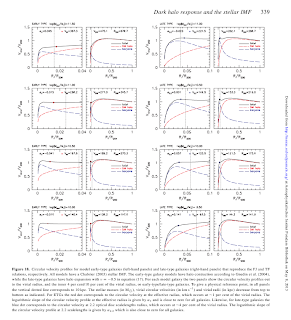 They look into the model circular velocity profiles (see attached) for models that reproduce the TF and FJRs, with Chabrier IMF. The velocity profiles look rather constant at higher radii, reaching the maximum at ~0.3 R_vir. (For the LTGs, they convert the velocity dispersion to v_circ picking a rather simple conversion factor between sqrt(2) and sqrt(3).) They claim that the flatness of the rotation curves does not depend strongly on the IMF and the halo response model, and 'is a natural consequence for galaxies embedded in LCDM haloes'.
Then they discuss possible mechanisms that would account for differences in IMF or halo response for ETGs and LTGs. The halo contraction/expansion may depend on galaxy morphology via a number of processes:
-- adiabatic contraction due to smooth accretion -- results in disk growth and SF, important for LTGs
-- wet major mergers -- result in halo contraction because gas settles in the center of a galaxy, transforms LTGs to ellipticals
-- dry major mergers ( for ETGs) -- halo contraction due to violent relaxation which mixes stars and DM
-- clumpy accretion/minor mergers: halo expansion due to dynamical friction. Clumps must be baryonic, so that's likely to occur at high redshifts (A. Dekel was arguing in Jerusalem that it must be the case).
-- feedback causes halo expansion, more important to LTGs and for higher redshifts.
-- bars -- halo expansion or contraction, not clear.
They sum it all up by saying that the key formation event that distinguishes ETGs from LTGs is a major merger (dry or wet), which causes halo contraction. For LTGs, haloes could expand due to a combination of clumpy cold accretion and intensive feedback.
The IMF may plausibly vary with redshift due to its alleged dependence on ISM temperature via the Jeans mass. Since ETGs form their stars earlier than LTGs, their IMF might be different. They discuss the van Dokkum & Conroy 2008 article on the different IMF at the cores of massive ellipticals, and conclude that this IMF would not fit for the other ETGs well.
All in all, they show that there is a degeneracy between IMF and the halo response to disk formation, and we cannot match the two for ETGs and LTGs if we want to reproduce the TFR. However, I'm puzzled here -- like in the previous Mo, Mao, White article, they do not model galaxy evolution in a self-contained way, and a model cannot show things that are not included in it. Mo, Mao & White include one set of parameters in their article, and get a set dependences on their parameters (like the disk formation time). Here Dutton et al. model rotation curves as functions of other parameters, and get dependence on another set of parameters. I think it's tricky to understand which parameters are really important, because in astrophysics we often have many coupled parameters, and it's not difficult to find correlations between them. It's more difficult to find out which ones are the fundamental ones, which really affect the TFR.
-- a question: what does it mean "TFR is an edge-on projection of the fundamental plane" (p. 323)?
(*) v2.2 for late-type galaxies and some measure of velocity proportional to dispersion at the effective radius for early types
Authors: Dutton, Conroy, van den Bosch et al., http://arxiv.org/abs/1012.5859
Year: 2011
The authors try to find the origins of the TF and Faber-Jackson relations, using a big sample of observed galaxies from SDSS, a set of observational scaling relations showing the distribution of baryons in galaxies, with constrains on the DM halo structure from simulations.
They claim in the introduction that the origin of TFR and FJR is the relation between the halo virial velocity and its virial mass, which scales as v_vir \propto M^(1/3). The relation between v_opt (*) and v_vir depends on 3 factors:
-- the contribution of baryons to v_opt
-- the structure of pristine (DM-only) haloes. The halo profiles are well-enough defined by the NFW profile.
-- and the halo response to the disk formation (contraction/expansion)
The biggest source of uncertainty for the first factor is the IMF, as most of the baryonic mass in galaxies (except the low-mass star-forming ones) is in stars.
The third factor, the halo response, is quite uncertain. It can be adiabatic or non-adiabatic contraction, or expansion due to a number of different processes.
They use a large number of observed relations (TF and FJ relations too) to constrain or predict unknown quantities in their analytic model, modelling the DM halo, bulges, disks, gas disks, constructing 3D models of their SDSS sample galaxies (~100 000 LTGs, ~160 000 ETGs).
They construct mass models for all those galaxies using various IMF and assumptions about the halo response. Then they compare them with the observed circular velocity -- stellar mass relations (I do not understand it at this point -- they already used the TFR as a constraint while solving for the halo contraction at a given IMF, so it is inbuilt in their model somehow?).
Nevertheless, they do not reproduce the zero-point of the TFR with the standard Chabrier IMF and standard adiabatic halo contraction model, as the velocity is overpredicted. They claim that it is possible to fix that by either assuming a different IMF, or changing the halo response, or having different halo concentrations (set by formation time or \sigma_8, they claim that both ways to do it do not solve the zero-point problem).
However, they find that early-type and late-type galaxies cannot have the same IMF and halo response. For any given halo response model, ETGs and LTGs must have different IMF normalisations to reproduce the TFR. If we assume a universal IMF, early-type galaxies require stronger halo contraction.
 They look into the model circular velocity profiles (see attached) for models that reproduce the TF and FJRs, with Chabrier IMF. The velocity profiles look rather constant at higher radii, reaching the maximum at ~0.3 R_vir. (For the LTGs, they convert the velocity dispersion to v_circ picking a rather simple conversion factor between sqrt(2) and sqrt(3).) They claim that the flatness of the rotation curves does not depend strongly on the IMF and the halo response model, and 'is a natural consequence for galaxies embedded in LCDM haloes'.
Then they discuss possible mechanisms that would account for differences in IMF or halo response for ETGs and LTGs. The halo contraction/expansion may depend on galaxy morphology via a number of processes:
-- adiabatic contraction due to smooth accretion -- results in disk growth and SF, important for LTGs
-- wet major mergers -- result in halo contraction because gas settles in the center of a galaxy, transforms LTGs to ellipticals
-- dry major mergers ( for ETGs) -- halo contraction due to violent relaxation which mixes stars and DM
-- clumpy accretion/minor mergers: halo expansion due to dynamical friction. Clumps must be baryonic, so that's likely to occur at high redshifts (A. Dekel was arguing in Jerusalem that it must be the case).
-- feedback causes halo expansion, more important to LTGs and for higher redshifts.
-- bars -- halo expansion or contraction, not clear.
They sum it all up by saying that the key formation event that distinguishes ETGs from LTGs is a major merger (dry or wet), which causes halo contraction. For LTGs, haloes could expand due to a combination of clumpy cold accretion and intensive feedback.
The IMF may plausibly vary with redshift due to its alleged dependence on ISM temperature via the Jeans mass. Since ETGs form their stars earlier than LTGs, their IMF might be different. They discuss the van Dokkum & Conroy 2008 article on the different IMF at the cores of massive ellipticals, and conclude that this IMF would not fit for the other ETGs well.
All in all, they show that there is a degeneracy between IMF and the halo response to disk formation, and we cannot match the two for ETGs and LTGs if we want to reproduce the TFR. However, I'm puzzled here -- like in the previous Mo, Mao, White article, they do not model galaxy evolution in a self-contained way, and a model cannot show things that are not included in it. Mo, Mao & White include one set of parameters in their article, and get a set dependences on their parameters (like the disk formation time). Here Dutton et al. model rotation curves as functions of other parameters, and get dependence on another set of parameters. I think it's tricky to understand which parameters are really important, because in astrophysics we often have many coupled parameters, and it's not difficult to find correlations between them. It's more difficult to find out which ones are the fundamental ones, which really affect the TFR.
-- a question: what does it mean "TFR is an edge-on projection of the fundamental plane" (p. 323)?
(*) v2.2 for late-type galaxies and some measure of velocity proportional to dispersion at the effective radius for early types
Tuesday, May 14, 2013
Daily Paper #3: Rotation rates, sizes and star formation efficiencies of a representative population of simulated disc galaxies
I was a bit late today, because I went to see a couple of talks at the HETDEX meeting. A couple of interesting points from there:
-- The LAE people are worried about selection bias arising due to galaxy spins' alignment with the large scale structure (http://arxiv.org/abs/1004.3611)
-- Cluster growth depends not only on the proto-cluster environment (i.e. the immediate neighbourhood), but on super-halo scales as well (it's probably better defined here: http://arxiv.org/abs/1109.6328)
...On to the paper:
Title: Rotation rates, sizes and star formation efficiencies of a representative population of simulated disc galaxies
Authors: McCarthy, Schaye et al.
Year: 2012, http://arxiv.org/abs/1204.5195 They use resimulated (SPH) Millenium sub-regions with selected representative mean densities, including baryonic physics. They include background UV/Xray radiation field that 'reionises' the simulations at z = 9 and the CMB. They model star formation using an effective prescription reproducing the Kennicut's relation and assuming Chabrier IMF, as well as yields and timing of nucleosynthesis and SN feedback.
Then they fit the surface brightness profiles of galaxies in 9 - 11.5 log M* range with a Sersic function and classify their galaxies into disc and spheroid-dominated usin n = 2.5 as the cut.
-- The stellar mass - rotation velocity relation:
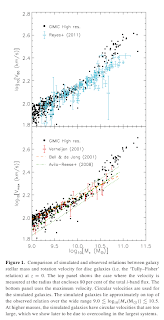 They examine this relation for their disk galaxy population (see the attached picture) and compare it with Reyes 2011 observations, claiming that this is the first cosmological hydrodynamical simulation that produces a population of galaxies consistent with the observed TFR. The slope is slightly higher, but in general, the agreement is really good. They use v80 (velocity at 80% light radius) and Vmax as the velocity measures. The velocities at their high-mass range are too big, and they claim that lack of prescription for AGN feedback may explain that.
The authors also discuss the scatter in TF relation, claiming that it is not possible to directly compare observed and simulated TF scatter without careful analysis of selection criteria and observational uncertainties.
Simulated spheroid galaxies follow the TFR well at this mass range, except for the most massive galaxies. The rotation curves of the galaxies with M* > 10.6 are not realistic (due to overcooling, too efficient SF of the highest mass haloes). Their simulated galaxies are also compatible with observed M* - size and star formation efficiency -- M* relations, up to the higher mass range.
One more quantity that simulations are compared with is the ratio of v_circ to v_200. If there is no significant halo expansion/contraction, this ratio should be roughly equal to 1.2 (Duffy 2010 writes more on halo expansion/contraction issue and impact on this ratio). Again, their results agree with this quite well up to log(M*) > 10.5.
They try to reproduce the main galaxy sequence at z = 0, comparing their results with SFR from Galex. Except for the lowest mass galaxies where their resolution is too small, it works well.
The section 4 is an interesting discussion of connection between SF efficiency, stellar mass function and the TF relation. They show that by assuming power-law shapes for halo mass function and stellar mass function in certain stellar mass range where this is valid, it is possible to match haloes (=velocities) and stellar masses using the abundance matching method, and reproduce TFR and SFR efficiency-M200 relations well (and maybe even constrain the faint end of the IMF). The way I understand it, the TFR arises due to the linear (in log-space) match between the halo mass function (set by cosmology) and the stellar mass function (set by IMF, SFR efficiency, thus feedback, etc.). I'll read Mo, van den Bosch and White 2010 for more discussion on this matter.
-- The LAE people are worried about selection bias arising due to galaxy spins' alignment with the large scale structure (http://arxiv.org/abs/1004.3611)
-- Cluster growth depends not only on the proto-cluster environment (i.e. the immediate neighbourhood), but on super-halo scales as well (it's probably better defined here: http://arxiv.org/abs/1109.6328)
...On to the paper:
Title: Rotation rates, sizes and star formation efficiencies of a representative population of simulated disc galaxies
Authors: McCarthy, Schaye et al.
Year: 2012, http://arxiv.org/abs/1204.5195 They use resimulated (SPH) Millenium sub-regions with selected representative mean densities, including baryonic physics. They include background UV/Xray radiation field that 'reionises' the simulations at z = 9 and the CMB. They model star formation using an effective prescription reproducing the Kennicut's relation and assuming Chabrier IMF, as well as yields and timing of nucleosynthesis and SN feedback.
Then they fit the surface brightness profiles of galaxies in 9 - 11.5 log M* range with a Sersic function and classify their galaxies into disc and spheroid-dominated usin n = 2.5 as the cut.
-- The stellar mass - rotation velocity relation:
 They examine this relation for their disk galaxy population (see the attached picture) and compare it with Reyes 2011 observations, claiming that this is the first cosmological hydrodynamical simulation that produces a population of galaxies consistent with the observed TFR. The slope is slightly higher, but in general, the agreement is really good. They use v80 (velocity at 80% light radius) and Vmax as the velocity measures. The velocities at their high-mass range are too big, and they claim that lack of prescription for AGN feedback may explain that.
The authors also discuss the scatter in TF relation, claiming that it is not possible to directly compare observed and simulated TF scatter without careful analysis of selection criteria and observational uncertainties.
Simulated spheroid galaxies follow the TFR well at this mass range, except for the most massive galaxies. The rotation curves of the galaxies with M* > 10.6 are not realistic (due to overcooling, too efficient SF of the highest mass haloes). Their simulated galaxies are also compatible with observed M* - size and star formation efficiency -- M* relations, up to the higher mass range.
One more quantity that simulations are compared with is the ratio of v_circ to v_200. If there is no significant halo expansion/contraction, this ratio should be roughly equal to 1.2 (Duffy 2010 writes more on halo expansion/contraction issue and impact on this ratio). Again, their results agree with this quite well up to log(M*) > 10.5.
They try to reproduce the main galaxy sequence at z = 0, comparing their results with SFR from Galex. Except for the lowest mass galaxies where their resolution is too small, it works well.
The section 4 is an interesting discussion of connection between SF efficiency, stellar mass function and the TF relation. They show that by assuming power-law shapes for halo mass function and stellar mass function in certain stellar mass range where this is valid, it is possible to match haloes (=velocities) and stellar masses using the abundance matching method, and reproduce TFR and SFR efficiency-M200 relations well (and maybe even constrain the faint end of the IMF). The way I understand it, the TFR arises due to the linear (in log-space) match between the halo mass function (set by cosmology) and the stellar mass function (set by IMF, SFR efficiency, thus feedback, etc.). I'll read Mo, van den Bosch and White 2010 for more discussion on this matter.
Friday, May 10, 2013
Daily Paper: The formation of galactic discs
Me and my supervisor agreed that I would read a paper a day and write it up, so I'll be copying the summaries here.
Title: The formation of galactic discs (http://adsabs.harvard.edu/abs/1998MNRAS.295..319M)
Authors: Mo, Mao, White
Year: 1998
It's actually a really important paper -- I'm glad not to have missed it. They model galactic disk formation (of pure exponential ones, though they address influence of a simple bulge model later) in 3 CDM cosmologies. The authors make 4 important assumptions:
1) The mass of a disk is a fixed fraction of its halo
2) The angular momentum of the disk is also a fixed fraction of that of the DM halo (later they find that the specific angular momenta of the disk and halo are similar, so these two ratios should be equal).
3) The disk is thin, has an exponential density profile and is centrifugally supported
4) Real galaxies are dynamically stable disks, i.e. they reject unstable models.
They calculate the halo mass function using Press-Schechter formalism (see Appendix), assume halo angular momentum distribution determined by N-body simulations and a constant mass-to light ratio, and NFW profile. They calculate the total energy of a truncated (to r_200) NFW halo using the virial theorem, the rotation curve corresponding to it (after accounting for adiabatic halo contraction and gravitational disk influence).
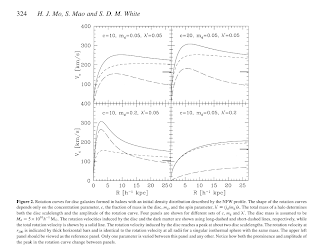
See the attached picture (Mo1998_rotcurves.png) for their results. They claim that the shape of a rotation curve depends on 3 parameters only: the halo concentration parameter c(see *), fraction of mass in the disk m_d, and the spin parameter.
There is a lot more in this paper, but they devote a significant section of it to Tully-Fisher relation, explaining the origins of its slope, zeropoint and intrinsic scatter.
The intrinsic scatter because of the first two factors cannot be smaller than 0.15 mag.
In conclusion, they show that it is possible to derive a realistic TF relation theoretically, however, I'm not sure if that is the only way it could arise? They do not include bulges, which are important for our sample, too. I am also unsure what do they mean with 'effective disk assembly redshift' at z <= 1.
* c == r_200/r_s, here r_200 -- the limiting radius of a halo, defined so that the mean density inside this radius is 200 times larger than the background density, r_s -- the disk scale length.
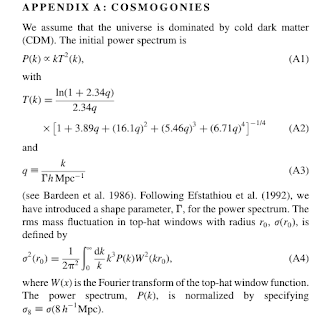
There is also a brief explanation of the \sigma_8 parameter -- see attached.
Title: The formation of galactic discs (http://adsabs.harvard.edu/abs/1998MNRAS.295..319M)
Authors: Mo, Mao, White
Year: 1998
It's actually a really important paper -- I'm glad not to have missed it. They model galactic disk formation (of pure exponential ones, though they address influence of a simple bulge model later) in 3 CDM cosmologies. The authors make 4 important assumptions:
1) The mass of a disk is a fixed fraction of its halo
2) The angular momentum of the disk is also a fixed fraction of that of the DM halo (later they find that the specific angular momenta of the disk and halo are similar, so these two ratios should be equal).
3) The disk is thin, has an exponential density profile and is centrifugally supported
4) Real galaxies are dynamically stable disks, i.e. they reject unstable models.
They calculate the halo mass function using Press-Schechter formalism (see Appendix), assume halo angular momentum distribution determined by N-body simulations and a constant mass-to light ratio, and NFW profile. They calculate the total energy of a truncated (to r_200) NFW halo using the virial theorem, the rotation curve corresponding to it (after accounting for adiabatic halo contraction and gravitational disk influence).
See the attached picture (Mo1998_rotcurves.png) for their results. They claim that the shape of a rotation curve depends on 3 parameters only: the halo concentration parameter c(see *), fraction of mass in the disk m_d, and the spin parameter.

There is a lot more in this paper, but they devote a significant section of it to Tully-Fisher relation, explaining the origins of its slope, zeropoint and intrinsic scatter.
- -- slope: They claim that it is a generic prediction of hierarchical structure formation models with CDM-like fluctuation spectra (which set the halo formation times and thus their concentration c distribution).
- -- zeropoint: mostly set on disk mass fraction, mass-to-light radio and the redshift at which a given disk was assembled. They claim that disks must have effectively formed at redshifts close to zero (?), unless we assume an unphysical mass-to-light ratio.
- -- scatter: they analyse possible sources of intrinsic scatter of the disks, and find that:
- --- a small amount of scatter comes from the spin parameter distribution
- --- scatter in concentration c also adds scatter to the TF relation (disks at more concentrated haloes spin faster).
- --- bulge is not included in their model, so bulge luminosity contribution is not accounted for -- that's a source of scatter as well
- --- mass-to-light ratio may vary, adding some more scatter
- --- formation times may vary as well, adding even more scatter.
The intrinsic scatter because of the first two factors cannot be smaller than 0.15 mag.
In conclusion, they show that it is possible to derive a realistic TF relation theoretically, however, I'm not sure if that is the only way it could arise? They do not include bulges, which are important for our sample, too. I am also unsure what do they mean with 'effective disk assembly redshift' at z <= 1.
* c == r_200/r_s, here r_200 -- the limiting radius of a halo, defined so that the mean density inside this radius is 200 times larger than the background density, r_s -- the disk scale length.
There is also a brief explanation of the \sigma_8 parameter -- see attached.

Monday, May 6, 2013
lit: Baryonic T-F relation
S. McGaugh et al, somehow the baryons know how many stars to form'.
There is also a reference to Mo 1998, which may provide insights into the origin of the T-F relation.
There is also a reference to Mo 1998, which may provide insights into the origin of the T-F relation.
Thursday, March 14, 2013
Fitting a model to data: lit review
Yesterday I showed some preliminary TF results at our group meeting, and it was rightly noted that the straight line fit I made was wrong. I've only included errors in one variable (velocity, obtained by using bootstrapping) in the fit, and made a mess of that by mixing the variables on the plot.
I've been thinking about how to do a proper fit when the data has uncertainties in both directions, and been revisiting this paper by Hogg et al.:
In the astrophysics literature (see, for example, the Tully Fisher literature, there is a tradition, when there are uncertainties in both directions, of fi tting the "forward" and "reverse" relations, that is, fi tting y as a function of x and then x as a function of y, and then splitting the diff erence between the two slopes so obtained, or treating the di fference between the slopes as a systematic uncertainty. This is unjusti ed.
Friday, February 15, 2013
lit: Intrinsic properties of SDSS galaxies
Maller et al.. It's important in many other ways, but here is an interesting excerpt on why TF relation is different:
However, with the notable exception of the Tully-Fisher relation these distributions and relations are traditionally measured in terms of the observed properties of galaxies. That is, the measurements used are K-corrected and corrected for foreground dust extinction, but no correction is attempted to compensate for the viewing angle from which the galaxies are observed. In contrast, the Tully-Fisher relation is not a relationship between a galaxy's observed luminosity and rotation velocity, but a relation between a galaxy luminosity and rotation velocity corrected for inclination. The inclination correction attempts to recover the intrinsic properties of a galaxy and not properties that are measured because of the particular angle from which the galaxy is viewed. For a long time there was great controversy over whether spiral galaxies are optically thin or optically thick (e.g., Holmberg 1958; Disney et al. 1989), but in the early 1990s it was established that galaxies become redder and fainter as they are inclined (e.g., Burstein et al. 1991).
However, with the notable exception of the Tully-Fisher relation these distributions and relations are traditionally measured in terms of the observed properties of galaxies. That is, the measurements used are K-corrected and corrected for foreground dust extinction, but no correction is attempted to compensate for the viewing angle from which the galaxies are observed. In contrast, the Tully-Fisher relation is not a relationship between a galaxy's observed luminosity and rotation velocity, but a relation between a galaxy luminosity and rotation velocity corrected for inclination. The inclination correction attempts to recover the intrinsic properties of a galaxy and not properties that are measured because of the particular angle from which the galaxy is viewed. For a long time there was great controversy over whether spiral galaxies are optically thin or optically thick (e.g., Holmberg 1958; Disney et al. 1989), but in the early 1990s it was established that galaxies become redder and fainter as they are inclined (e.g., Burstein et al. 1991).
Friday, January 11, 2013
lit: a few articles by FvdB
One of our lecturers, Frank van den Bosch, pointed me to a few articles that might be useful for the topics I'm currently studying:
Spatial and kinematic alignments between central and satellite halos
Probing the Intrinsic Shape and Alignment of Dark Matter Haloes using SDSS Galaxy Groups
The Tully-Fisher Zero Point Problem
Spatial and kinematic alignments between central and satellite halos
Probing the Intrinsic Shape and Alignment of Dark Matter Haloes using SDSS Galaxy Groups
The Tully-Fisher Zero Point Problem
Thursday, December 20, 2012
Monday, December 17, 2012
lit: Tully-Fisher relation in SDSS bands
Pizagno et al., attention-worthy. After skimming through it, I had an idea of running GALFIT through my sample and getting better values of b/a ratios and PA's. I have a pretty good value of the sky, so why not model it?
Thursday, August 16, 2012
Bulges and ellipticals
I read an interesting article on the train, Galaxy Bulges and Elliptical Galaxies, lecture notes by D. Gadotti. Dimitri had helped us a lot with the MICE decomposition.
He sums up a great deal of recent research regarding the structure of galaxies. A few main points:
He sums up a great deal of recent research regarding the structure of galaxies. A few main points:
- the components that we call bulges are not necessarily old 'scaled down' ellipticals as we often hear: there are classical bulges, disk-like bulges, 'box-peanuts', which may coexist or overlap.
- 'box-peanuts' are thought to be the inner parts of bars, not separate components
- classical bulges are kinematically hot, i.e. supported by their velocity dispersion. disk-like bulges are kinematically cold, i.e. supported by their rotation velocity.
- there's an interesting section on photometric bulge recognition, and why the arbitrary cut on n=2 is what it is, arbitrary. I tend to believe that any classification has to be data-driven, so I'll keep the alternative suggestions in mind.
- another interesting part is about the scaling relations, i.e. the fundamental plane and F-J relation. I didn't know that the FP can be derived directly from the virial theorem!
- F-J and L-size relations seem to be nonlinear, according to the data.
Subscribe to:
Posts (Atom)